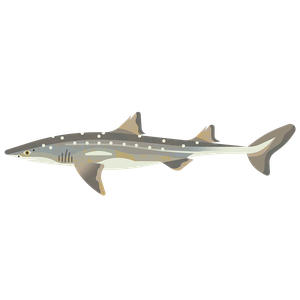
Porbeagle
Lamna nasus
What to check for
Location
Location
Location refers to two things:
- Where the fish population or stock lives, e.g., North Sea, or South Pacific.
- Who is managing the fishery. If it says “All areas”, this means that our scoring for management covers the same area as the fish stock.
North East Atlantic: All areas
Technical location
Technical location
A global system is used to split the ocean into different zones, areas, and subdivisions. Each zone is indicated by a number and/or letter. By law, this must be shown on all unprocessed seafood sold in the EU and UK, alongside the fishing method used to catch it. Look for these details on the packet to match your seafood to our ratings.
All areas
Caught by
Caught by
Hook & line (longline)
Longlining uses a long fishing line with baited hooks. There can be hundreds of hooks on one line. The type and size of the hook, the bait used, and the position of the longline (at the surface, mid-water, or on the sea floor) vary depending on what fishers are trying to catch.
Net (gill or fixed)
Gillnetting uses a net, suspended in the water, that is anchored to the seabed. It is kept vertical by buoys, to create a wall of netting that fish swim into and become entangled. The mesh size and length of time the nets are left at sea varies, depending on where they are fishing and what they are targeting.
Net (pelagic trawl)
Pelagic trawling involves towing a net through mid-water or at the surface, usually without touching the seabed. It can be towed by one boat or a pair of boats. Shoals of fish are targeted using equipment such as sonar.
Hook & line (longline), Net (gill or fixed), Net (pelagic trawl)
Rating summary
Porbeagle biomass is currently within precautionary limits and is not subject to overfishing. However, it remains vulnerable to overexploitation. In both the EU and UK, it has been illegal to fish for, retain on board, tranship or land porbeagle since 2010. There is no other management plan in place for porbeagle in this area. Historically, porbeagle was an extremely valuable shark taken in trawl, line and gillnet fisheries, however, it is no longer a targeted fishery and any bycatch, must be released.
Rating last updated January 2023.
How we worked out this Rating
Stock status
The size and health of a fish population, or 'stock', that is being targeted by fishermen is a crucial indicator of whether a fishery is sustainable. If the stock is too small to withstand fishing, it is at risk of crashing. We look at how big the stock is, and how much pressure there is from fishing, to assess this. The target level that many fisheries aim for is 'Maximum Sustainable Yield' - the most fish that can be caught year after year whilst keeping the population at a healthy size.
Porbeagle biomass is currently within precautionary limits and is not subject to overfishing. However, it remains vulnerable to overexploitation.
There is thought to be a single stock of porbeagle in the Northeast Atlantic which extends from the Barents Sea to Northwest Africa. The low productivity and aggregating nature of this species makes it particularly vulnerable to overexploitation.
Relative biomass of porbeagle has declined from a high in the early 1900's to below Blim in the 1970's. It fluctuated below Blim until 2012 when it began to increase. In 2022, relative biomass (B/BMSY) is above Blim but just below MSY Btrigger.
Relative fishing pressure has fluctuated throughout the time series. Since a zero Total Allowable Catch (TAC) was introduced in 2010, fishing pressure has been below FMSY.
Previous advice from ICES was for a zero catch from 2020-2023. However, this stock was benchmarked in 2022 after improvements in data availability and the stock is now doing better than previously thought. Therefore, ICES now advises that when the MSY approach is applied, catches in 2023 and 2024 should be no more than 219 and 231 tonnes respectively. Landings in 2021 were estimated at 7 tonnes and as the fishery is still prohibited, this is not expected to increase.
Management
Good management is vital to be sure that fishing doesn't cause fish populations to decline. We look at whether regulations follow the best available scientific advice, how well compliance is monitored and enforced, and whether this is effective in maintaining healthy fish stocks.
In both the EU and UK, it has been illegal to fish for, retain on board, tranship or land porbeagle since 2010. There is no other management plan in place for porbeagle in this area.
Capture method
Environmental impacts of fishing vary hugely, depending on the method used and where it's happening. We look at whether the fishing gear being used could have an effect on seabed habitats, and if so, how severe might this be. We also review whether it catches any other species by accident (bycatch), and what effect this might have on those species - especially if they're Endangered, Threatened, or Protected.
Historically, porbeagle was an extremely valuable shark taken in trawl, line and gillnet fisheries, however, it is no longer a targeted fishery and any bycatch, must be released.
It was utilised primarily for human consumption, including fins and high value meat. Porbeagle is also taken by recreational fishers, but catches and post-release survival are unquantified. This species was formerly targeted in longline fisheries and it is also a bycatch species in gillnet and pelagic trawl fisheries. Anecdotal information indicates that porbeagle is a regular bycatch in the Norwegian pelagic trawl fishery for blue whiting in the Norwegian Sea. Due to the fishing method, whereby the catch is pumped on board, all specimens are reportedly dead when caught.
Discarding is known to occur but has not been fully quantified. Discard survival has not been estimated but it is likely to be low for netters and trawlers. The inclusion of porbeagle in the EU prohibited species has increased the discards at sea.
References
Ellis, J., Farrell, E., Jung, A., McCully, S., Sims, D. & Soldo, A. 2015. Lamna nasus. The IUCN Red List of Threatened Species 2015: e.T11200A48916453. Available at https://dx.doi.org/10.2305/IUCN.UK.2019-3.RLTS.T11200A500969.en [Accessed on 10.11.2022].
EU. 2019. Council Regulation (EU) 2019/124 of 30 January 2019 fixing for 2019 the fishing opportunities for certain fish stocks and groups of fish stocks, applicable in Union waters and, for Union fishing vessels, in certain non-Union waters. Official Journal of the European Union, L 29: 1-166. Available at http://data.europa.eu/eli/reg/2019/124/oj [Accessed on 10.11.2022].
ICES. 2022. Porbeagle (Lamna nasus) in subareas 1–10, 12, and 14 (the Northeast Atlantic and adjacent waters). In Report of the ICES Advisory Committee, 2022. ICES Advice 2022, por.27.nea, Available at https://doi.org/10.17895/ices.advice.19754584 [Accessed on 10.11.2022].
ICES. 2022. Working Group on Elasmobranch Fishes (WGEF). ICES Scientific Reports, 4:74. Available at http://doi.org/10.17895/ices.pub.21089833 [Accessed on 08.01.2023].
OSPAR. 2021. Status Assessment 2021 - Porbeagle. Available at https://oap.ospar.org/en/ospar-assessments/committee-assessments/biodiversity-committee/status-assesments/porbeagle/ [Accessed on 08.01.2023].
Shark Trust. 2020. Porbeagle ID Guide. Available at https://www.sharktrust.org/faqs/porbeagle-id-guide [Accessed on 08.01.2023].
Sustainable swaps
Learn more about how we calculate our sustainability ratings.
How our ratings work
Add impact to your inbox
Join the movement: get updates on the issues you care about.
We'll email you inspiring stories about the work we're doing to save and recover our oceans, and news about our urgent campaigns for positive change.