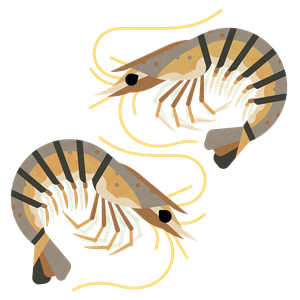
King prawn
Litopenaeus vannamei
What to check for
Location
Location
The location for farmed fish can refer to a region or country, or it can be global. We do not provide ratings at individual farm level. We rate farmed fish produced in a distinct area, using the same production method in the same environment. Sometimes, especially when looking at certified farmed fish, how they are produced and managed is the same the world over, so the rating applies globally.
South America: Ecuador, All Areas; Honduras, All Areas
Production method
Pond, semi-intensive
Ponds are constructed near the sea and are used to grow prawns. Semi -intensive ponds refers to the amount of inputs that go in and the amount of prawns produced. With semi-intensive pond production some commercial feeds and chemicals may be used to support growth and prawn health if required, these ponds produce less prawns that intensive systems.Pond, semi-intensive
Certification
EU Organic
Organic Certification Standards for farmed Atlantic salmon set comprehensive standards for the cultivation of salmon which includes third party auditing, inspection and enforcement procedures, standards include hatchery production and feed production. These standards led to better overall environmental performance including: reduced stocking densities ; limited use of medicines and chemicals in production; feed must be produced from off-cuts and by-products of human consumption fisheries and organic certified plant raw materials (no GMO) and stringent regulations and third party on site auditing.
Soil Association
The Soil Association developed the world’s first organic standards in the 1960s .Soil Association certified producers must meet strict European laws about the production of organic food. They must also go further in key areas such as animal welfare, protecting human health, and safeguarding the environment.
EU Organic
Soil Association
Rating summary
Organic King prawns (L. vannamei) from Ecuador and Honduras rely on traceable, responsible terrestrial feed ingredients, and the marine component of the feed includes trimmings, although whole fish can also be used. Organic certification ensures best practices and guidelines are in place for animal welfare and humane slaughter and also mitigates many areas of environmental concern. The production of Organic King prawn does not allow the destruction of mangroves for pond construction, pond discharges are low and only minimal chemical treatments are used, if at all and all juveniles are hatchery based. Surrounding wild shrimp populations are also not impacted by disease or escapes from farms. However, there are still improvements that could be made. Lethal control of predators may still be used and Environmental Impact Assessments are not in place for smaller farms. Management and regulation of the aquaculture sector, while comprehensive, still needs to be better resourced to ensure effectiveness.
This rating is based on full compliance with certification requirements. Commercial buyers should therefore ensure that full compliance has been achieved in order for this rating to be applicable.
Rating last updated: October 2021
How we worked out this Rating
Feed
What feed is given to farmed fish, where it comes from and how much is used is one of the most important aspects of fish farming. In this section we look at how sustainable the feed is and how much fish is included in the diet.
Organic production of King prawns (L. vannamei) in Ecuador and Honduras relies on traceable, responsible terrestrial feed ingredients. The marine component of the feed includes trimmings but whole fish can also be used.
Semi-intensive pond farms are characterised by low stocking densities and the use of only supplemental or no added feed. With large amounts of crop ingredients in these feeds, the feed footprint is relatively small. Organic certification standards require ingredients to be traceable, responsibly sourced and sustainable. Marine by-products within the feed provide fishmeal and fish oil content, vegetable ingredients are organically and responsibly sourced.
The dependency of wild caught fish used in fish meal and fish oil for farmed King prawn currently indicates that they produce more fish protein than is required in the diet, making them a net producer rather than a net consumer.
Environment
The environmental impacts of aquaculture depend on what fish is farmed, how and where. It could be habitat damage, chemical use, pollution, freshwater use or parasites. In this section we look at the environmental impacts of greatest concern for that species and production method. Some species, such as shellfish, have very little impact, whilst others may give us cause for concern.
Organic production of King Prawn does not allow the destruction of mangroves for pond construction. Only minimal essential chemical treatments are used, if at all, and pond discharges are low. Surrounding wild shrimp populations are not impacted by diseases or escapes from farms, or used to supply juveniles. Methods of predator control are unknown, but may include lethal control.
Historically, the destruction and loss of mangrove habitat due to shrimp farming activities has been one of the main environmental concerns with this production system around the world. To the contrary, in Honduras, most shrimp farms are sited away from high-value habitats, on salt flats behind mangrove forest fringes. In Ecuador, significant conversion of estuary habitat to shrimp farms occurred prior to 1999. Recent marginal conversion on the estuary edge is not considered to represent ongoing loss of functionality in the estuary.
Organic prawn farms avoid chemical usage and low stocking densities employed in King prawn (or Whiteleg shrimp) production, results in minimal chemical and antibiotic use. Likewise, feed inputs are also low and effluent discharge is considered minimal. Organic production systems are required to minimise the impact on the surrounding aquatic and terrestrial environment. The production of King prawns in Ecuador and Honduras relies on hatchery-reared juveniles.
Biosecurity measures set out in organic certification standards limit disease outbreaks and escapes. Shrimp are susceptible to an array of diseases, particularly viral pathogens. Although farmed shrimp diseases can be transferred to wild populations, these wild stocks are not generally impacted in a significant way. Escapes of farmed King prawns, from semi-intensive pond farms, is also a risk but it is unlikely that any population level impacts would occur as a result of competitive or genetic interactions with wild King prawns, if escapes occurred.
Shrimp farming often requires the control of local predators. Organic standards permit lethal control in certain circumstances (i.e., when non-lethal methods have proved ineffective), in line with EU regulations. However, lethal control is not the norm, more usually the use of noise deterrents (such as firecrackers) and dogs are adequate to scare predators away from shrimp ponds. Lethal control of predators has been documented in some countries but unlikely to affect the population size of the affected species.
Fish health and welfare
Fish health and welfare is a concern for many consumers. High welfare standards are an indication of good farm management, we look to see if there are industry wide welfare standards in place, and if these include humane slaughter.
Organic certification standards ensure that best practices and guidelines are in place to address the welfare needs of animals within organic aquaculture.
Health and welfare standards are referenced throughout the standards. Specific requirements address health and welfare of aquaculture animals, and humane slaughter, where techniques must render fish immediately unconscious and insensible to pain.
Management
How aquaculture is regulated and how effective those regulations are is an important aspect of farmed fish production. We also look to see if aquaculture is included in broader environmental management plans. In this management section we also award scores for globally recognised certification standards, as certified seafood requires verification of environmental performance and traceability.
Independent organic certification standards address many of the issues of environmental concern and ensure compliance. Honduras and Ecuador require environmental impact assessments for larger farms, but not those of a smaller scale. Management and regulation of the aquaculture sector is comprehensive, however it needs to be better resourced to ensure effectiveness.
As a result of the significant impact diseases had on the sector during the 1990s, present-day shrimp farmers in Ecuador and Honduras mainly favour semi-intensive production practices. These historical disease issues also prompted greater scrutiny of the regulations governing the sector and resulted in a more robust legal framework being put in place. However, a review of the sector indicates that current governance may not be adequately resourced to effectively manage the potential environmental impacts of the industry, particularly as the sector expands and production increases. Although organic standards address many of the production practice specific issues the issues of overarching regulation and management of the sector remain unchanged.
The Soil Association defines organic farming as a system of farming and food production. Organic farmers aim to produce high quality food, using methods that benefit our whole food system, from people and planet, plant health to animal welfare. The score for this section reflects EU Organic and Soil Association certified producers that are in full compliance with the standard.
References
Commission Regulation (EC) No 710/2009 of 5 August 2009 amending Regulation (EC) No 889/2008 laying down detailed rules for the implementation of Council Regulation (EC) No 834/2007, as regards laying down detailed rules on organic aquaculture animal and seaweed production. Available at https://eur-lex.europa.eu/legal-content/EN/TXT/?uri=uriserv%3AOJ.L_.2009.204.01.0015.01.ENG [Accessed on 25.02.2021].
Coze, A. and Nava, A. 2009. Review of environmental impact assessment and monitoring of aquaculture in Latin America. In FAO. Environmental impact assessment and monitoring of aquaculture. FAO Fisheries and Aquaculture Technical Paper. No. 527. Rome, FAO. pp. 395–454. Available at http://www.fao.org/tempref/docrep/fao/012/i0970e/i0970e01e.pdf [Accessed on 23.03.2021].
FAO. 2021a. National Aquaculture Legislation Overview: Honduras. Available at http://www.fao.org/fishery/legalframework/nalo_honduras/en [Accessed on 23.03.2021].
FAO. 2021b. National Aquaculture Legislation Overview: Ecuador. Available at http://www.fao.org/fishery/legalframework/nalo_ecuador/en [Accessed on 23.03.2021].
FAO. 2021c. General view of the nation aquaculture sector: Ecuador. Available at http://www.fao.org/fishery/countrysector/naso_ecuador/fr [Accessed on 23.03.2021].
FAO. 2021d. Overview of the nation aquaculture sector: Honduras. Available at http://www.fao.org/fishery/countrysector/naso_honduras/es [Accessed on 23.03.2021].
Global Aquaculture Alliance. 2020. Shrimp Eyestalk Ablation Researcher Wins 2020 Global Aquaculture Innovation Award. Available at https://www.aquaculturealliance.org/blog/2020-aquaculture-innovation-award-winner/ [Accessed on 23.03.2021].
Green, K. and Lart, W. 2013. Seafish Responsible Sourcing Guide – Warm water prawns – March 201. Available for download at https://www.seafish.org/document/?id=d443878e-d50b-4d78-9d68-8b5c393ed0c0 [Downloaded 24.02.2021].
Gee, J. 2015. Monterey Bay Aquarium Seafood Watch Assessment: Whiteleg Shrimp (L. vannamei), Honduras: ponds. Available for download at https://www.seafoodwatch.org/recommendation/shrimp/shrimp-whiteleg-honduras-ponds?species=156 [Downloaded 24.02.2021].
Kramer, L. 2020. Innovation Award 2020 Finalist: Simao Zacaris’s shrimp eyestalk ablation research. Available at https://www.aquaculturealliance.org/advocate/innovation-award-2020-finalist-simao-zacarias-shrimp-eyestalk-ablation-research/ [Accessed on 23.03.2021].
OMARSA. 2017. Company website for Ecuadorian shrimp farm. Available at http://www.omarsa.com.ec/ [Accessed on 24.02.2021].
Regulation (EU) 2018/848 of the European Parliament and of the Council of 30 May 2018 on organic production and labelling of organic products and repealing Council Regulation (EC) No 834/2007. Available at https://eur-lex.europa.eu/legal-content/EN/TXT/?uri=uriserv%3AOJ.L_.2018.150.01.0001.01.ENG [Accessed on 25.02.2021].
Seafish. 2020. Aquaculture Profile: White Leg Prawn. Available at https://www.seafish.org/responsible-sourcing/aquaculture-farming-seafood/species-farmed-in-aquaculture/aquaculture-profiles/white-leg-prawn/ [Accessed on 24.02.2021].
Seafoodwatch. 2021. Monterey Bay Aquarium Seafood Watch Assessment: White Shrimp (L. vannamei), Ecuador: Semi-intensive ponds. Available for download at https://www.seafoodwatch.org/recommendations/search?query=%3Aspecies%3BWhiteleg%20shrimp%3Acountry%3BEcuador [Downloaded 22.03.2021].
Soil Association. 2021. Soil Association Standards Aquaculture. Version 18.6, pp.3-78. Available at https://www.soilassociation.org/media/18614/aquaculture-standards.pdf [Accessed on 25.02.2021].
Soil Association. 2021. Summary of standard changes: Organic standards documents updated Friday 12th February 2021 – Version 18.6. Available at https://www.soilassociation.org/media/19109/sa-standards-summary-of-changes.pdf [Accessed on 25.02.2021].
STIP. 2021. Seafood Trade Intelligence Portal: Shrimp in Ecuador. Available at https://seafood-tip.com/sourcing-intelligence/countries/ecuador/ [Accessed on 24.02.2021].
Tacon, A., Jory, D. and Nunes, A. 2013. Shrimp feed management: issues and perspectives. In M.R. Hasan and M.B. New, eds. On-farm feeding and feed management in aquaculture. FAO Fisheries and Aquaculture Technical Paper No. 583. Rome, FAO. pp. 481–488. Available at http://www.fao.org/tempref/FI/CDrom/T583/root/18.pdf [Accessed on 25.02.2021].
Wybran, J. 2015. Shrimp News Interviews Dr. James Wyban The Father of SPF Shrimp. Shrimp News International. Available at http://www.shrimpnews.com/FreeReportsFolder/HistoryFolder/HistoryUnitedStates/DrJamesWybanFatherOfSPF.html [Accessed on 26.02.2021].
Sustainable swaps
Learn more about how we calculate our sustainability ratings.
How our ratings work
Add impact to your inbox
Join the movement: get updates on the issues you care about.
We'll email you inspiring stories about the work we're doing to save and recover our oceans, and news about our urgent campaigns for positive change.