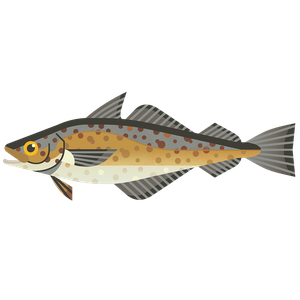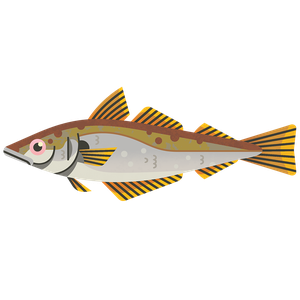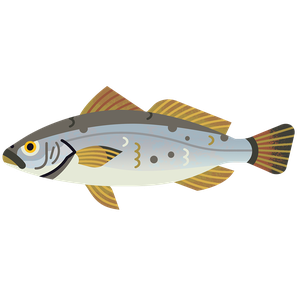
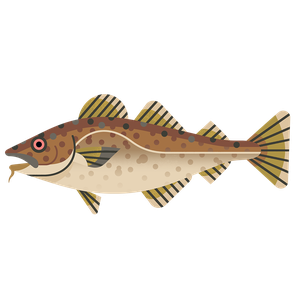
Atlantic cod
Gadus morhua
What to check for
Location
Location
Location refers to two things:
- Where the fish population or stock lives, e.g., North Sea, or South Pacific.
- Who is managing the fishery. If it says “All areas”, this means that our scoring for management covers the same area as the fish stock.
Celtic Seas (southern), English Channel (west): All areas
Technical location
Technical location
A global system is used to split the ocean into different zones, areas, and subdivisions. Each zone is indicated by a number and/or letter. By law, this must be shown on all unprocessed seafood sold in the EU and UK, alongside the fishing method used to catch it. Look for these details on the packet to match your seafood to our ratings.
7f: Bristol Channel, 7g: Celtic Sea (North), 7h: Celtic Sea (South), 7e: English Channel (West), 7j: Southwest of Ireland (East), 7k: Southwest of Ireland (West)
Caught by
Caught by
Bottom trawl (beam)
Beam trawling involves towing a net over the seabed. The net is held open by a heavy beam. There can be tickler chains or chain matting, which drag along the front of the net. They disturb the fish, causing them to swim up and into the net, which is then hauled onto the boat.
Bottom trawl (otter)
Otter trawling involves towing a net over the seabed. The net is held open by two panels, known as otter boards. Fish are herded between the boards and into the net, which is then hauled onto the boat.
Hook & line (handline)
Handlining varies depending on where it is happening and what species is being targeted. In general, it uses a baited line from a stationary boat. The fisher pulls the line in by hand, rather than using rods or poles. It’s also known as one-by-one fishing because the fish are landed onto the boat one at a time.
Net (demersal seine)
Demersal seining involves placing a net on the seabed and slowly closing it. As ropes move over the seabed to close the net, they herd fish into it. This method sometimes involves towing the net along the seabed. It is also known as flyshooting, Danish seining, and Scottish seining, depending on how it's set up.
Net (gill or fixed)
Gillnetting uses a net, suspended in the water, that is anchored to the seabed. It is kept vertical by buoys, to create a wall of netting that fish swim into and become entangled. The mesh size and length of time the nets are left at sea varies, depending on where they are fishing and what they are targeting.
Bottom trawl (beam), Bottom trawl (otter), Hook & line (handline), Net (demersal seine), Net (gill or fixed)
Rating summary
The Celtic Sea cod population is at dangerously low levels, and there is no plan in place to help it recover. Therefore, it is Fish to Avoid.
Rating last updated: January 2023
How we worked out this Rating
Stock status
The size and health of a fish population, or 'stock', that is being targeted by fishermen is a crucial indicator of whether a fishery is sustainable. If the stock is too small to withstand fishing, it is at risk of crashing. We look at how big the stock is, and how much pressure there is from fishing, to assess this. The target level that many fisheries aim for is 'Maximum Sustainable Yield' - the most fish that can be caught year after year whilst keeping the population at a healthy size.
Celtic Sea cod scores a Critical Fail and the rating is a default red due to continued fishing pressure despite the stock having dangerously low reproductive capacity. There is no precautionary recovery plan in place.
This stock is assessed by the International Council for the Exploration of the Sea (ICES). Catches peaked in 1989 at over 19,000 tonnes, but have since declined. Celtic Sea cod is no longer a target species, but is caught as bycatch in haddock and whiting fisheries. Recent catches have averaged around 1,600 tonnes.
ICES advises that there should be zero catch in 2023 because the reproductive capacity of the stock or spawning stock biomass (SSB) is below minimum scientific levels needed to sustain the population (Blim). SSB in 2022 is 1,196 tonnes, while Blim is 4,200t. The stock is therefore in a severely depleted state.
Fishers in the Celtic Sea have a bycatch allowance. In 2021 landings exceeded allowable catches by 47% (1,360 versus the 644 tonnes allowed). Fishing pressure on the stock in 2021 was 1.05. This is higher than levels associated with Maximum Sustainable Yield (FMSY, 0.29) and close to the maximum limit (Flim, 1.13). The stock is therefore subject to heavy overfishing.
Discards of cod in the area continue to remain relatively high and accounted for more than 50% of the catch in 2021, largely due to small young fish being caught as bycatch.
If fishing pressure in 2023 matches the level in 2022, the stock is projected to increase by 1.5%. If scientific advice was followed, and there was zero catch, the stock is projected to increase by 162%. Recruitment of young fish into the stock has been very variable over time, but has been very low since 2012, with a small peak in 2014.
Management
Good management is vital to be sure that fishing doesn't cause fish populations to decline. We look at whether regulations follow the best available scientific advice, how well compliance is monitored and enforced, and whether this is effective in maintaining healthy fish stocks.
There are a number of management measures for this stock, but they are generally not effective and certainly have not achieved a recovery of cod in this area. There is currently no recovery plan in place.
Cod is not a target species in the Celtic Sea area, but is caught as bycatch in haddock fisheries. Cod is mainly caught in otter trawls and landed by Ireland, France, UK and Belgium. The EU has a multiannual plan (MAP) for stocks in Western Waters, which applies to this stock, but the MAP doesn’t contain any cod-specific measures. It does allow for the fishery to be closed if Blim has been reached, as is the case with this stock. The UK is not signed up to the MAP.
The main management measure is a limit on how much cod can be caught as bycatch (Total Allowable Catch, TAC). Landings have declined considerably in recent years from over 11,000 tonnes in 2012 to 1,300t tonnes in 2021. However, ICES recommends zero catch for this stock as it is at critically low levels. Therefore, management is not following scientific advice.
In 2021, the bycatch TAC was 805 tonnes. 627 tonnes was landed, but an estimated total of 1,360 tonnes, including discards, was caught. Therefore, the TAC is not being effectively enforced.
ICES projects that if haddock is fished at maximum sustainable levels in 2023, there will be 1,002 tonnes of cod bycatch. This would result in a very small cod biomass increase from 1,196t to 1,261t. It would keep the stock well below the point of reproductive impairment (Blim), which is 4,200t. Further reductions in haddock catch could allow slightly bigger increases in cod biomass. Therefore, the haddock fishery needs to be reduced in order to support recovery of the cod stock.
The TAC area does not relate directly to the stock area. Cod caught in the southern Irish Sea (division 7a South, rectangles 33E2 and 33E3) is considered to be part of this stock. On average, around 18% of Irish Sea landings have been reallocated to this stock over the past 5 years. This equates to 1.4% of official landings in divisions 7.e-k. When TAC and stock areas don't match, it could risk displacing fishing effort to areas outside of the TAC limit, but still affecting the stock.
Other management measures for cod include protections for spawning areas. This includes the Trevose Box - an area between Cornwall and Ireland (ICES rectangles 30E4, 31E4, and 32E3) that is closed to fishing during spawning season. Evidence suggests that the Trevose closure has been effective at minimising fishing, although there appears to be some Irish fishing activity in the area.
Technical measures include a minimum mesh size (MMS) for beam and otter trawlers in Subarea 7 and a Minimum Conservation Reference Size (MCRS) of 35 cm. As cod mature between 31 - 74 cm, this does not fully protect juveniles. There are restrictions to improve selectivity, and modification of gears to reduce cod bycatch. This includes square mesh panels with a large mesh size, which according to recent ICES reports should help to reduce cod catches. However, ICES also indicates that the effectiveness of these measures should be monitored.
In 2021, estimated discards accounted for over 50% of the total catch. This is higher than recent years, when it has been around 20%. Discarding has increased as TACs have become more restrictive. Most discards are juvenile fish aged 1 or 2. In 2021, around 80% of the total catch by number was 1 or 2 year old fish. Therefore, selectivity measures have not reduced the pressure on juvenile cod. Otter trawls accounted for 63% of discards whilst landing 71% of cod caught in the area. Beam trawls have a high discard rate, with 9% of landings but 21% of discards. Implementation of the landing obligation from 2019 and allocation of bycatch TAC had resulted in reduced discards but area misreporting is understood to continue.
Despite implementation of the above management measures, the stock status of cod in the Celtic area has not improved indicating that current management approaches are not effective.
In the UK, the Fisheries Act came into force in January 2021. The Act requires the development of Fisheries Management Plans (FMPs) (replacing EU Multi-Annual Plans). Cod has been included in the Celtic Sea and Western Channel Demersal Fisheries Management Plan with a timetable for preparation and publication between 2023-2025.
FMPs have the potential to be very important tools for managing UK fisheries. They will set out the policies to secure the long-term sustainability of our fish stocks for current and future generations and can include (data allowing):
- Targets for fishing pressure and biomass, with effective management to meet them;
- Timeframes for stock recovery;
- Use of technologies such as Remote Electronic Monitoring (REM) to support data collection, improve transparency and accountability;
- Consideration of wider environmental impacts of the fishery.
Capture method
Environmental impacts of fishing vary hugely, depending on the method used and where it's happening. We look at whether the fishing gear being used could have an effect on seabed habitats, and if so, how severe might this be. We also review whether it catches any other species by accident (bycatch), and what effect this might have on those species - especially if they're Endangered, Threatened, or Protected.
Most Celtic Sea cod is caught by otter trawls, which can cause damage to the seabed and may have bycatch of vulnerable species.
Demersal otter trawls accounted for over 71% of landings in 2020. They use doors to hold nets open that penetrate the seabed, resulting in the abrasion of habitat features. The ground sweeps and bridles of the trawl can have similar abrasive impact. However, the impact of trawling is not only related to the gear type and modifications but also the location and scale in which trawling occurs. For example, areas that are used to natural disturbance through tides and waves, are less sensitive to habitat impacts. Additionally, areas not used to mobile towed gears are typically more sensitive.
Around 9% of Celtic Sea cod catches are by beam trawls, which penetrate the seabed, resulting in the abrasion of habitat features and bycatch of benthic species such as corals and sponges.
Seine nets caught 11% of cod in 2020. This gear can have habitat impacts, although to a lesser extent than trawling. Bycatch of vulnerable sharks and rays has been reported for seine nets in the area.
Trawling is also associated with discarding of unwanted fish, i.e. undersized and/or non-quota and/or over-quota species. However, Celtic Sea cod is not targeted, but is caught as bycatch itself by the haddock fishery. Therefore, bycatch of other non-vulnerable species is not scored.
Trawl gears in the Celtic Seas have been observed to have a high bycatch of elasmobranchs, including vulnerable species. However, there is a lack of information regarding catch rates and there is low observer coverage. Therefore it is difficult to fully understand the impact of the fishery on ETP species.
The main mitigation measures are Marine Protected Areas, some of which are designated for benthic features. If those MPAs were found to be subjected to bottom trawling, we would consider it a default red rating unless there is evidence (e.g. environmental impact assessment) indicating the activity does not damage the integrity of the site.
References
Eigaard, O.R., Bastardie, F., Breen, M., Dinesen, G.E., Hintzen, N.T., Laffargue, P., Mortensen, L.O., Nielsen, J.R., Nilsson, H.C., O'Neill, F.G., Polet, H., Reid, D.G., Sala, A., SkOld, M., Smith, C., Sorensen, T.K., Tully, O., Zengin, M., Rijnsdorp, A.D., 2016. Estimating seabed pressure from demersal trawls, seines, and dredges based on gear design and dimensions. ICES Journal of Marine Science, Volume 73, Issue suppl 1. Pages i27-i43. https://doi.org/10.1093/icesjms/fsv099.
EU, 2019. Regulation (EU) 2019/1241 of the European Parliament and of the Council of 20 June 2019 on the conservation of fisheries resources and the protection of marine ecosystems through technical measures. https://eur-lex.europa.eu/legal-content/EN/TXT/?uri=CELEX%3A02019R1241-20220806 [Accessed on 13/12/2022].
EU, 2020. Regulation (EU) 2020/123 of 27 January 2020 fixing for 2020 the fishing opportunities for certain fish stocks and groups of fish stocks, applicable in Union waters and, for Union fishing vessels, in certain non-Union waters. Available from: https://eur-lex.europa.eu/legal-content/EN/TXT/PDF/?uri=CELEX:32020R0123&from=EN [Accessed on 4.11.2021].
Froese, R. and Pauly, D. (Editors), 2022. Atlantic cod, Gadus morhua. Available at : https://www.fishbase.se/summary/gadus-morhua.html [Accessed on 13/12/2022].
Hiddink JG, Jennings S, Sciberras M, Szostek CL, Hughes KM, Ellis N, et al., 2017. Global analysis of depletion and recovery of seabed biota after bottom trawling disturbance. Proceedings of the National Academy of Sciences Aug 2017, 114 (31) 8301-8306; DOI: 10.1073/pnas.1618858114.
ICES, 2007. EU request on Trevose closure - ICES special request. Available at: https://www.ices.dk/sites/pub/Publication Reports/Advice/2007/Special Requests/EC Trevose closure.pdf [Accessed on 4.11.2021].
ICES, 2022. Cod (Gadus morhua) in divisions 7.e-k (eastern English Channel and southern Celtic Seas). In Report of the ICES Advisory Committee, 2022. ICES Advice 2022, cod.27.7e–k. https://doi.org/10.17895/ices.advice.19447898. [Accessed on 12.12.22].
ICES, 2022. EU standing request on catch scenarios for zero-TAC stocks; cod (Gadus morhua)in divisions 7.e–k (Celtic Sea). In Report of the ICES Advisory Committee, 2022. ICES Advice 2022, sr.2022.09d. Available at https://doi.org/10.17895/ices.advice.21456339 [Accessed on 23.01.2023].
ICES, 2022. Working Group for the Celtic Seas Ecoregion (WGCSE). ICES Scientific Reports. 4:45. 1413pp. Available at http://doi.org/10.17895/ices.pub.19863796 [Accessed on 23.01.2023].
Kynoch RJ, Fryer RJ, Neat FC. 2015. A simple technical measure to reduce bycatch and discard of skates and sharks in mixed-species bottom-trawl fisheries. ICES Journal of Marine Science, Volume 72, Issue 6, July/August 2015, Pages 1861–1868, https://doi.org/10.1093/icesjms/fsv037.
Silva FJ, Ellis JR, Catchpole TL., 2012. Species composition of skates (Rajidae) in commercial fisheries around the British Isles and their discarding patterns. J Fish Biol. 80:1678–1703. https://doi.org/10.1111/j.1095-8649.2012.03247.x.
UK Government, 2022. Joint Fisheries Statement. November 2022. Available at https://assets.publishing.service.gov.uk/government/uploads/system/uploads/attachment_data/file/1119399/Joint_Fisheries_Statement_JFS_2022_Final.pdf [Accessed on 23.01.2023].
van Denderen PD, Bolam SG, Hiddink JG, Jennings S, Kenny A, Rijnsdorp AD, van Kooten T, 2015. Similar effects of bottom trawling and natural disturbance on composition and function of benthic communities across habitats. Mar Ecol Prog Ser 541:31-43. https://doi.org/10.3354/meps11550.
Sustainable swaps
Learn more about how we calculate our sustainability ratings.
How our ratings work
Add impact to your inbox
Join the movement: get updates on the issues you care about.
We'll email you inspiring stories about the work we're doing to save and recover our oceans, and news about our urgent campaigns for positive change.