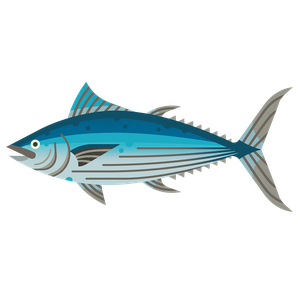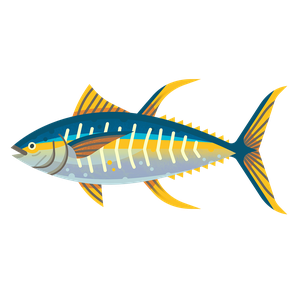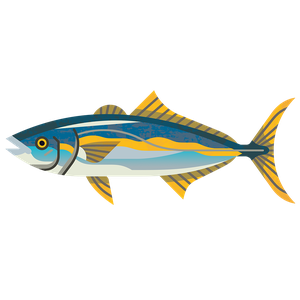
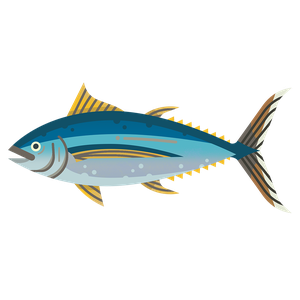
Southern bluefin tuna
Thunnus maccoyii
What to check for
Location
Location
Location refers to two things:
- Where the fish population or stock lives, e.g., North Sea, or South Pacific.
- Who is managing the fishery. If it says “All areas”, this means that our scoring for management covers the same area as the fish stock.
Southern Ocean: All areas
Technical location
Technical location
A global system is used to split the ocean into different zones, areas, and subdivisions. Each zone is indicated by a number and/or letter. By law, this must be shown on all unprocessed seafood sold in the EU and UK, alongside the fishing method used to catch it. Look for these details on the packet to match your seafood to our ratings.
58 - Indian Ocean, Antarctic and Southern, 88 - Pacific, Antarctic, All areas, All areas, All areas
Caught by
Caught by
Hook & line (longline)
Longlining uses a long fishing line with baited hooks. There can be hundreds of hooks on one line. The type and size of the hook, the bait used, and the position of the longline (at the surface, mid-water, or on the sea floor) vary depending on what fishers are trying to catch.
Hook & line (pole & line)
Pole & line, or baitboat, fishing involves a number of rods being set up on a boat. They might be operated by hand or mechanically. Bait is used to attract the target species. It’s also known as one-by-one fishing because the fish are landed onto the boat one at a time.
Net (purse seine on aggregating devices or free-schooling fish)
Purse seining involves encircling a school of fish with a net, tightening it at the bottom so the fish can’t swim out, then hauling it onto the boat. Fish aggregating devices (FADs) are sometimes used to increase catches. They are floating objects that fish naturally gather around for shelter.
Hook & line (longline), Hook & line (pole & line), Net (purse seine on aggregating devices or free-schooling fish)
Rating summary
Southern bluefin tuna is listed as Endangered on the IUCN Red List and therefore is a Fish to Avoid.
Rating last updated January 2024
How we worked out this Rating
Stock status
The size and health of a fish population, or 'stock', that is being targeted by fishermen is a crucial indicator of whether a fishery is sustainable. If the stock is too small to withstand fishing, it is at risk of crashing. We look at how big the stock is, and how much pressure there is from fishing, to assess this. The target level that many fisheries aim for is 'Maximum Sustainable Yield' - the most fish that can be caught year after year whilst keeping the population at a healthy size.
Southern bluefin tuna is listed as Endangered on the IUCN Red List. It therefore receives a Critical Fail and is a default red rating. It is still in a heavily overfished state, but is gradually recovering. It is not subject to overfishing.
Southern bluefin tuna (SBT) is assessed and managed by the Commission for the Conservation of Southern Bluefin Tuna (CCSBT). It has been fished since the 1940s. During that time, the stock has continuously declined, reaching a low of around 10% of its unfished level in 2009. Since then, it is estimated that the stock has been increasing by 5% per year.
The last stock assessment was carried out in 2023 using data up to 2022, and the next one is expected in 2026.
In 2023, the stock was thought to be at 23% of unfished levels, and 85% of levels associated with Maximum Sustainable Yield (MSY). This is based on Total Reproductive Output (akin to Spawning Stock Biomass). It had therefore reached its interim stock rebuilding objective (20% by the year 2035). The new rebuilding objective is now to reach 30% of unfished levels by 2035, which is the level associated with MSY, estimated to be 33,207 tonnes. The Marine Conservation Society considers 20% of unfished levels to be equivalent to Blim. This means that the increases in abundance have led to the stock raising above Blim, however the stock is still at an increased risk of suffering reduced reproductive capacity. This means that while the increases in abundance are very encouraging, the stock is still at dangerously low levels.
Catch in 2022 was 17,138 tonnes. This was equivalent to 46% of the level associated with MSY (F/Fmsy = 0.46). The stock is therefore not subject to overfishing.
Stock projections indicate that SBT is on track to reach 30% of unfished levels by 2035 with a 51% probability. The Total Allowable Catch (TAC) was therefore increased by the maximum amount of 3000 tonnes, resulting in an increase from 17,647 tonnes per year in 2021- 2023 to 20,647 tonnes per year for 2024 – 2026.
Fishing for juvenile SBT is common, especially by purse seiners, which then slowly tow the fish in large net pens back to the coast. Here, they are fattened for later sale on the sashimi market. Individual fish can fetch upwards of £100,000. Any reduction in fishing will increase the rate of stock rebuilding. The CCSBT scientific committee have noted that the benefits of reducing catches of juveniles could take around 8 years to show, because SBT are only fully mature around age 11.
Management
Good management is vital to be sure that fishing doesn't cause fish populations to decline. We look at whether regulations follow the best available scientific advice, how well compliance is monitored and enforced, and whether this is effective in maintaining healthy fish stocks.
Owing to its high value, southern bluefin tuna has been considerably overfished, but a rebuilding plan seems to have been effective and the stock is gradually recovering.
Tuna, marlin, and swordfish are highly migratory species, found on the high seas and in numerous countries' waters. This makes harmonised and effective management challenging. Regional Fisheries Management Organisations (RFMOs) are responsible for monitoring and managing these stocks on behalf of the countries that access them. However, the degree to which management is implemented, monitored, and enforced by each country varies significantly.
While southern bluefin tuna ranges throughout the southern Atlantic, Pacific and Indian Oceans, the Regional Fisheries Management Organisations (RFMOs) for these oceans essentially defer management of the stock to the Commission for the Conservation of Southern Bluefin Tuna (CCSBT). A 2021 interim performance review of management by CCSBT described its scientific work and its incorporation into management as 'exceptional'. However, it noted that significant issues relating to bycatch of non-target species remain.
The primary conservation measure for Southern bluefin tuna (SBT) is a Total Allowable Catch (TAC), split between 7 countries. Roughly 1/3 each is allocated to Japan and Australia, with the remainder split between the Republic of Korea, Taiwan, New Zealand, Indonesia, and South Africa. TACs are set in accordance with the long-term management plan for the fishery.
The stock has been successfully rebuilt to its interim target, which was 20% of unfished levels by 2035. The new objective is now to reach a level associated with MSY, which is 30% of unfished levels, by 2035. Stock projections indicate that SBT is on track to meet this target.
TAC was set at 20,647t for 2024 – 2026 based on the continued stock growth. This is an increase of 3,000t from 2021 – 2023 levels (17,647t), the maximum allowed under the management plan. Reported catch has been below the global TAC every year since 2017. The estimated total catch for 2022 was 17,138t. Due to positive stock projections, there is a high probability that TAC for 2027 – 2029 will increase by 2,000-3,000t. Some flexibility is provided for limited carry-forward of unfished allocations between quota years.
In addition to catch limits, in 2016, the Commission banned the use of large-scale driftnets on the high seas where it might lead to catches of southern bluefin tuna. This reduced fishing effort for SBT, to an extent.
The CCSBT has a Catch Documentation Scheme (CDS) for southern bluefin tuna. All southern bluefin tuna products must be accompanied by documentation which includes details of the vessel and area of catch, which will help monitor catches and trade. In addition, the CCSBT have developed a register of vessels that are authorized to catch southern bluefin tuna, as well as an annually-reviewed register of vessels carrying out Illegal, Unreported and Unregulated (IUU) fishing. Members and cooperating non-members of the CCSBT are required to refuse the import of this species caught by vessels not on the authorised list. Vessels fishing for SBT must use vessel monitoring systems, allowing satellites to track vessel activity.
The CCSBT aims for 10% of fishing activity by each gear type (mainly longline and purse seine) to be monitored by observers. In 2021 and 2022, this target was not met. In 2022, some countries did not meet the 10% observer coverage. Observer coverage of transhipments at sea has increased, however some countries are still not meeting requirements. This is where IUU activity is a risk. Scientific recommendations are for a minimum of 20%, and therefore current observer coverage is inadequate.
There are some compliance concerns in this fishery. Indonesia exceeded its catch allowance in 2019 and 2020, but has agreed to pay back its over-catches gradually from 2022 to 2026. There are also significant catch documentation issues for South Africa, and the country has failed to meet a number of targets in 2022 and 2023 for resolving these issues. Japan did not meet scientific observer or inspection requirements in 2022.
As the fishery operates within the jurisdiction of other RFMOs, vessels are also expected to adhere to the management and conservation measures of these intergovernmental organisations. CCSBT works to ensure its own regulations are compatible with those of other RFMOs.
Capture method
Environmental impacts of fishing vary hugely, depending on the method used and where it's happening. We look at whether the fishing gear being used could have an effect on seabed habitats, and if so, how severe might this be. We also review whether it catches any other species by accident (bycatch), and what effect this might have on those species - especially if they're Endangered, Threatened, or Protected.
In this fishery there are significant concerns about the bycatch of endangered seabirds.
Around 67% of southern bluefin tuna (SBT) catches are by longlining, and there are ongoing concerns about very high levels of seabird deaths in this fishery. Purse seining is responsible for about 30%, with some caught by pole and line. Purse seining can have some bycatch issues, although it is less of a concern than longlining. Pole and line is a relatively low-impact method, although it does use other fish species for bait. Reporting on bycatch is not comprehensive enough to understand the true impact of the fisheries on vulnerable species. A 2021 interim performance review of management by CCSBT noted that there are significant issues relating to bycatch of non-target species.
The area of biggest concern is the bycatch of seabirds. Estimates indicate that on average at least 5,000 birds were killed by SBT longliners each year from 2017-2020. There appears to be a decline in the deaths for 2020, which could be relating to poor data, or it may indicate that mitigation is working. However, data for 2021 and 2022 was poor. The SBT fishery has more overlap with albatrosses than any other tuna fishery, covering 22 albatross species as well as 7 petrel species. This includes endangered and critically endangered species such as the Tristan albatross and sooty albatross, whose declines are thought to be owing to longline fishing. A preliminary 2019 risk assessment found that for 9 species of albatross and petrel, bycatch by southern hemisphere longlining was at levels that would cause populations to decline. Based on the current rates of bycatch the increase in TAC has the potential to cause estimated 1,900 more lethal seabird interactions annually.
There are some mitigation measures to reduce bycatch, but compliance is too low. In addition, mitigation does not follow recommended best practice by ACAP (the Agreement on the Conservation of Albatrosses and Petrels). The only legally binding measure is to use Tori poles (bird scarers) in all longline fisheries south of 30 degrees south. ACAP recommends the simultaneous use of weighted branch lines, bird scaring lines and night setting, or hook-shielding or underwater bait setting devices.
Shark bycatch also occurs, again primarily by longlining. 12 species are considered to be relevant to the fishery, and therefore must be reported on, including porbeagle and the endangered shortfin and longfin makos. However, other species are being caught, including blue shark and crocodile shark, so additional reporting is needed. In 2021, the Ecologically Related Species Working Group of CCSBT confirmed its previously agreed advice for all shark species caught in SBT fisheries, that there were currently no specific concerns about shark bycatch that warranted additional mitigation requirements.
Other bycatch could include turtles and marine mammals, but data on interactions is poor.
CCSBT requires SBT vessels to comply with the ecologically-related-species measures of the relevant tuna RFMOs for the area where they are fishing. On average, around 78% of the SBT catch is from the Indian Ocean, 17% from the Pacific, and 5% from the Atlantic. Vessels must therefore comply with the measures of one of three tuna commissions (IOTC, WCPFC, and ICCAT). However, these RFMOs don't necessarily follow best practice in their regulations. There is a target level of 10% observer coverage of catch and effort, but compliance with this is patchy and it has been suggested that a target of 20% on longliners would be more appropriate. Some countries have said that low observer coverage makes it more difficult for them to identify and tackle non-compliance in their own fleets.
References
Abraham, E., Richard, Y., Walker, N., Gibson, W., Daisuke, O., Tsuji, S., Kerwath, S., Winker, H., Parsa, M., Small, C. and Waugh, S., 2019. Assessment of the risk of surface longline fisheries in the Southern Hemisphere to albatrosses and petrels, for 2016. CCSBT-ERS/1905/17 prepared for the 13th Meeting of the Ecologically Related Species Working Group of the Commission for the Conservation of Southern Bluefin Tuna. Available at https://www.ccsbt.org/en/system/files/ERSWG13_17_NZ_Assessment_RiskOfSurfaceLonglineFisheries_SouthernHemisphere.pdf [Accessed on 09.12.2024].
ACAP, 2023. ACAP Review of mitigation measures and Best Practice Advice for Reducing the Impact of Pelagic Longline Fisheries on Seabirds. Reviewed at the Thirteenth Meeting of the Advisory Committee, Edinburgh, United Kingdom, 22 - 26 May 2023. Available at https://www.acap.aq/resources/bycatch-mitigation/mitigation-advice/4548-acap-2023-pelagic-longlines-mitigation-review-and-bpa/file [Accessed on 26.01.2024].
ACAP, 2022. Conservation Status of Albatrosses and Petrels and Advice on Reducing their Bycatch in CCSBT Longline Fisheries. CCSBT-ERS/2203/16 presented to the 14th Meeting of the Ecologically Related Species Working Group. CCSBT-ERS/2203/BGD 01. Online, 21 - 25 Mar 2022. Available at https://www.ccsbt.org/system/files/ERSWG14_16_ACAP_update_spp%20%26%20BPA_2022.pdf [Accessed on 26.01.2024].
ACAP & BirdLife International, 2019. An update on the status and trends of ACAP- listed albatrosses and petrels in the CCSBT area. CCSBT-ERS/1905/22 presented to the 13th Meeting of the Ecologically Related Species Working Group, 28-31 May 2019, Canberra. Available at https://www.ccsbt.org/en/system/files/ERSWG13_22_ACAP_StatusSummary_ACAPspp_2019.pdf [Accessed on 26.01.2024].
CCSBT, 2019. Shark Species of Relevance to the CCSBT. In: The Thirteenth meeting of the Ecologically Related Species Working Group of the CCSBT (ERSWG13). CCSBT-ERS/1905/06, Canberra, Australia. Available at https://www.ccsbt.org/en/system/files/ERSWG13_06_Shark%20Species%20of%20Relevance%20to%20the%20CCSBT.pdf [Accessed on 26.01.2024].
CCSBT, 2023. Annual Report on Members’ implementation of ERS measures and performance with respect to ERS. In: CCSBT - 14th Meeting of the Ecologically Related Species Working Group. CCSBT-CC/2310/05, Online. Available at https://www.ccsbt.org/system/files/2023-09/jp_CC18_05_AnnualReportOnMembersERSPerformance.pdf [Accessed on 26.01.2024].
CCSBT, 2023. Report of the Eighteenth Meeting of the Compliance Committee. 5-7 October 2022, Busan, Korea. Available at https://www.ccsbt.org/sites/default/files/userfiles/file/docs_english/meetings/meeting_reports/ccsbt_30/report_of_CC18.pdf [Accessed on 19.01.2024].
CCSBT, 2023. Report on the Twenty Eighth Meeting of the Scientific Committee. 1 September 2023, Online. Available at: https://www.ccsbt.org/sites/default/files/userfiles/file/docs_english/meetings/meeting_reports/ccsbt_30/report_of_SC28.pdf [Accessed on 19.01.2024].
CCSBT, 2023. Report of the Thirtieth Annual Meeting of the Commission for the Conservation of Southern Bluefin Tuna. 12 October 2023, Busan, Korea. Available at https://www.ccsbt.org/sites/default/files/userfiles/file/docs_english/meetings/meeting_reports/ccsbt_30/report_of_CCSBT30.pdf [Accessed on 19.01.2024].
CCSBT, 2024. Operational Resolutions and Other Important Documents. Available at https://www.ccsbt.org/en/content/operational-resolutions-and-other-important-documents [Accessed on 26.01.2024].
Collette, B.B., Boustany, A., Fox, W., Graves, J., Juan Jorda, M. & Restrepo, V., 2021. The IUCN Red List of Threatened Species 2021: Thunnus maccoyii. e.T21858A170082633. Available at https://dx.doi.org/10.2305/IUCN.UK.2021-2.RLTS.T21858A170082633.en [Accessed on 19.01.2024].
Sustainable swaps
Learn more about how we calculate our sustainability ratings.
How our ratings work
Add impact to your inbox
Join the movement: get updates on the issues you care about.
We'll email you inspiring stories about the work we're doing to save and recover our oceans, and news about our urgent campaigns for positive change.