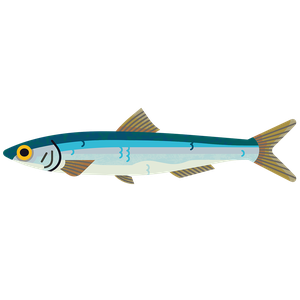
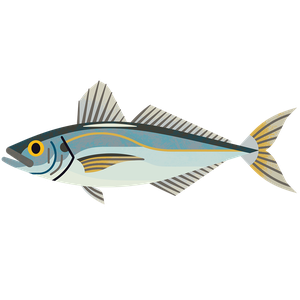
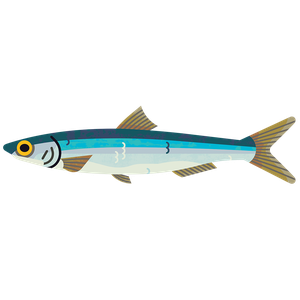
Herring in the Irish Sea (South), Celtic Sea and southwest of Ireland is below safe biological levels and there are no measures or plans in place to help it recover. Therefore, it receives a critical fail for stock status and is a default red rating.
Stock assessments are carried out annually by the International Council for the Exploration of the Sea (ICES). The most recent stock assessment was published in 2025 using data up to 2024. The next assessment is expected in 2026.
The stock assessment defines reference points for fishing pressure (F) and biomass (B). For fishing pressure, there is a target to keep F at or below Maximum Sustainable Yield (MSY). For biomass, there is no target. However, there is a trigger point (MSY BTrigger). Below this level, F should be reduced to allow the stock to increase. Because BMSY is not defined, the Good Fish Guide applies its own definition of 1.4 x MSY BTrigger.
The spawning-stock biomass (SSB) of herring within this area significantly decreased from around 200,000 tonnes in the late 1950s to around 7,500t in the 1970s. It has fluctuated since then, but reached an all-time low of 7,207t in 2018. There has been a small increase since then to 20,065t in 2024 and the short term forecast predicts a further increase in 2025 to 22,292t. However, this remains below the level at which the stock's ability to reproduce may be impaired (Blim: 34,000 tonnes). The stock is therefore in a very overfished state, outside safe biological limits, and suffering reduced reproductive capacity. Due to this this ratings receives a critical fail.
Fishing mortality (F) had been above levels associated with Maximum Sustainable Yield (FMSY, 0.26) for most of the history of the fishery. In 2013 it reached a low of 0.20, then dramatically increased to 1.11 in 2017. It declined again in 2020 to an all-time low of 0.017. In 2024, F was 0.058 remaining low and below FMSY. This indicates that the stock is not subject to overfishing.
ICES advises that when the MSY approach and precautionary considerations are applied, there should be zero catch in 2026. Zero catch has been recommended since 2020 because there are no catch scenarios that will allow the stock to recover to above Blim by 2027.
Recruitment of young fish into the stock has been declining since 2011 (956,829 t), and is thought to have reached an all-time low in 2021 (56,685 t). Recruitment have been increasing since then with 286,770 in 2024. However, recruitment in 2025 is estimated to decline to 124,841t. These estimates are uncertain, due to a lack of data.
Juvenile Celtic Sea herring mix with the Irish Sea stock, but the level of mixing is unknown. This could affect management and advice.
For this autumn-spawning stock, the SSB is determined at spawning time and influenced by fisheries between 1st April and spawning (October). Herring stocks are surveyed using acoustic surveys, but as they have been observed close to the sea bed in recent years this may not be the most reliable estimate, and it makes the stock assessment more uncertain. SSB is consistently overestimated and fishing mortality is consistently underestimated, so the assessment is considered to be highly uncertain. However, the uncertainty of the assessment does not impact the outcome of the advice.
Area 7h (Celtic Sea South) is part of the management area, but it is unclear if it is part of the stock.