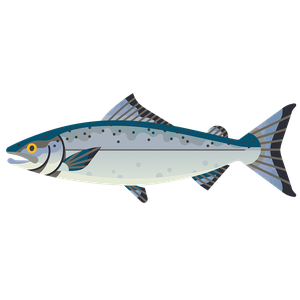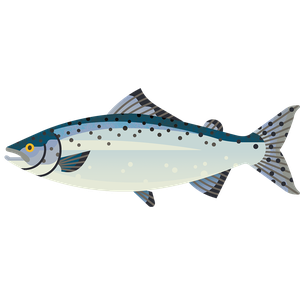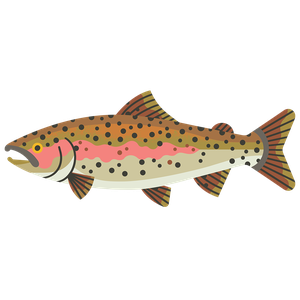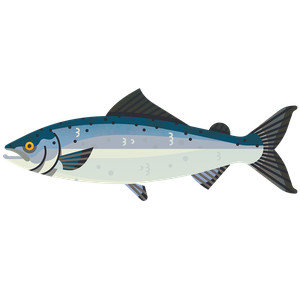
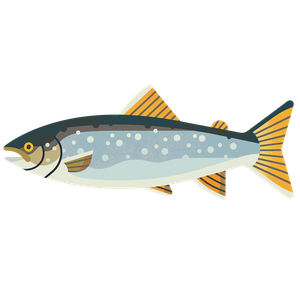
Atlantic salmon
Salmo salar
What to check for
Location
Location
Location refers to two things:
- Where the fish population or stock lives, e.g., North Sea, or South Pacific.
- Who is managing the fishery. If it says “All areas”, this means that our scoring for management covers the same area as the fish stock.
NE Atlantic (Scotland): Rivers listed as Grade 2 or 3 by Marine Scotland
Technical location
Technical location
A global system is used to split the ocean into different zones, areas, and subdivisions. Each zone is indicated by a number and/or letter. By law, this must be shown on all unprocessed seafood sold in the EU and UK, alongside the fishing method used to catch it. Look for these details on the packet to match your seafood to our ratings.
All areas
Caught by
Caught by
Net (drift)
Driftnetting uses a net, suspended in the water, that drifts with the current. It is kept vertical by buoys, to create a wall of netting that fish swim into and become entangled. The mesh size and length of time the nets are left at sea varies, depending on where they are fishing and what they are targeting.
Net (gill or fixed)
Gillnetting uses a net, suspended in the water, that is anchored to the seabed. It is kept vertical by buoys, to create a wall of netting that fish swim into and become entangled. The mesh size and length of time the nets are left at sea varies, depending on where they are fishing and what they are targeting.
Net (drift), Net (gill or fixed)
Rating summary
Wild Atlantic salmon stocks are depleted over much of their range. In Scotland, each year, Marine Scotland carry out an assessment of the conservation status of each river. ICES advises that when the MSY approach is applied, fishing should only take place on salmon from rivers where stocks have been shown to be at full reproductive capacity. The Scottish Government has identified 12 high level pressures impacting salmon in Scotland and further afield. Management measures in place to protect declining stocks include prohibiting the retention of salmon caught in coastal waters and the requirement of mandatory catch-and-release of Atlantic salmon in areas which fall below their defined conservation level.
This rating applies to rivers listed as Grade 2 or 3 by Marine Scotland.
Rating last updated June 2023.
How we worked out this Rating
Stock status
The size and health of a fish population, or 'stock', that is being targeted by fishermen is a crucial indicator of whether a fishery is sustainable. If the stock is too small to withstand fishing, it is at risk of crashing. We look at how big the stock is, and how much pressure there is from fishing, to assess this. The target level that many fisheries aim for is 'Maximum Sustainable Yield' - the most fish that can be caught year after year whilst keeping the population at a healthy size.
Wild Atlantic salmon populations are at historically low levels and scientific advice recommends that no catch takes place.
In line with advice from the North Atlantic Salmon Conservation Organisation (NASCO) the conservation status of stocks is assessed on a river by river basis, except those areas where fishery catch cannot be assigned to individual rivers. The Conservation of Salmon (Scotland) Regulations 2016 regulates the killing of Atlantic salmon in inland waters, managing stocks on an annual basis by categorising their conservation status.
The conservation status of each stock is defined using the probabilities of meeting the conservation limit over a five-year period. Rather than a simple pass or fail stocks are allocated to one of three grades each with their own recommended management actions. Grade 1 rivers (29 proposed in 2023) are rivers in which exploitation is sustainable and no additional management action is currently required. Grade 2 rivers (31 proposed in 2023) are those in which management action is necessary to reduce exploitation and the need for mandatory catch and release will be reviewed annually. Grade 3 rivers (113 proposed in 2023) are those In which exploitation is unsustainable and management actions are required to reduce exploitation for a year. In 2023, only 1 river has improved its grading, while 20 have moved down a grade.
In general terms the Regulations: prohibit the retention of salmon caught in coastal waters; permit the killing of salmon within inland waters where stocks are above a defined conservation limit i.e. those rivers accorded grade 1 or 2 status for the fishing season; require mandatory catch and release of salmon in areas which fall below their defined CL following the assessment of salmon stocks i.e. grade 3 rivers.
Statutory conservation measures ensure that no salmon is taken in Scotland before 1 April each year. ICES advises that when the MSY approach is applied, fishing should only take place on salmon from rivers where stocks have been shown to be at full reproductive capacity. Mixed-stock fisheries present particular threats, and should be managed based on the individual status of all stocks exploited in the fishery.
Management
Good management is vital to be sure that fishing doesn't cause fish populations to decline. We look at whether regulations follow the best available scientific advice, how well compliance is monitored and enforced, and whether this is effective in maintaining healthy fish stocks.
Wild salmon in Scotland are managed by Marine Scotland. There are a variety of management measures in place, including a ban on selling rod caught salmon.
The North Atlantic Salmon Commission (NASCO) has responsibility for managing salmon stocks at the international level. ICES provides scientific advice to NASCO on salmon stocks since it was established in 1983. Despite management measures aimed at reducing exploitation in recent years, there has been little improvement in the status of stocks over time.
In Scotland salmon fishing is governed by detailed legislation, imposing a variety of controls on all types of fishing. The Aquaculture and Fisheries (Scotland) Bill is the primary legislation for management of fisheries in Scotland. Part 2 of the Bill deals with salmon and freshwater fisheries and largely amends the Salmon and Freshwater Fisheries (Consolidation) (Scotland) Act 2003, particularly in relation to governance by District Salmon Fisheries Boards (DSFBs) and management of salmon fisheries.
The Association of Salmon Fishery Boards is the representative body for Scotland's 41 District Salmon Fishery Boards (DSFBs) including the River Tweed Commission (RTC), which have a statutory responsibility to protect and improve salmon and sea trout fisheries. District Salmon Fishery Boards and Fishery Trusts remain the foundation of effective fisheries management in Scotland. Many of the fish caught by anglers using rod and line are voluntarily released. Catch and Release in the rod fishery has served to reduce levels of exploitation, notably in the early months of the year. In some local cases catch and release has been implemented on a statutory basis.
In 2009 in England and Wales, the Environment Agency introduced carcass tagging to restrict the potential for illegal salmon trade. The Salmon Carcass Tagging (Scotland) Regulation 2016 introduced mandatory tagging in Scotland, bringing it in line with the rest of the UK and the Republic of Ireland. Under these regulations the only source of wild Scottish Atlantic salmon which may be purchased are those caught from net and cobble fisheries in Category 1 or 2 (inland) waters. It is an offence to sell rod caught wild Scottish Atlantic salmon. The Conservation of Salmon (Scotland) Regulations 2016 prohibits the retention of salmon caught in coastal waters.
Capture method
Environmental impacts of fishing vary hugely, depending on the method used and where it's happening. We look at whether the fishing gear being used could have an effect on seabed habitats, and if so, how severe might this be. We also review whether it catches any other species by accident (bycatch), and what effect this might have on those species - especially if they're Endangered, Threatened, or Protected.
There is limited knowledge on the impacts of salmon fishing on the environment and wider ecosystem.
All salmon fishing and sea trout fishing rights in Scotland, including in the sea, are private, heritable titles, which may be held separately from any land. Historically, they have fallen into one of three broad categories: fixed engine fisheries - are restricted to the coast and must be set outside estuary limits; net and coble fisheries - generally operate in estuaries and the lower reaches of rivers; and rod and line fisheries - generally operate within rivers and above tidal limits.
Although taken by anglers with rod and line, river anglers cannot sell their catch. Because numbers of wild salmon are declining, many of the fish caught by anglers are now returned to rivers unharmed so that they may go on to spawn. This practice is known as catch-and-release.
Salmon fisheries are thought to have only minor impact on the marine ecosystem. However, the exploitation of salmon in freshwater may affect the riverine ecosystem through changes in species composition but there is limited knowledge on the magnitude of these effects.
References
Cefas, EA and NRW. 2021. Salmon Stocks and Fisheries in England and Wales in 2021. Available at https://assets.publishing.service.gov.uk/government/uploads/system/uploads/attachment_data/file/1093963/SalmonReport-2021-assessment.pdf [Accessed on 20.06.2023].
ICES. 2023. North Atlantic salmon stocks. In Report of the ICES Advisory Committee, 2023. ICES Advice 2023, sal.oth.all. Available at https://doi.org/10.17895/ices.advice.22699276 [Accessed on 20.06.2023].
ICES. 2023. Working Group on North Atlantic Salmon (WGNAS). ICES Scientific Reports. 5:41. 478 pp. Available at https://doi.org/10.17895/ices.pub.22743713 [Accessed on 20.06.2023].
NASCO. Salmon at sea. Available at https://salmonatsea.com/ [Accessed on 20.06.2023].
NASCO. NASCO Implementation Plan for the period 2019-2024. Available at https://www2.gov.scot/Resource/0054/00546369.pdf [Accessed on 20.06.2023].
Myrvold, K.M., Mawle, G. W., Andersen, O. & Aas, Ø. 2019. The Social, Economic and Cultural values of wild Atlantic salmon. A review of literature for the period 2009-2019 and an assessment of changes in values. NINA Report 1668. Norwegian Institute for Nature Research. Available at https://brage.nina.no/nina-xmlui/handle/11250/2627172?locale-attribute=no [Accessed on 20.06.2023].
Scottish Government. Salmon and recreational fisheries. Available at https://www.gov.scot/policies/salmon-and-recreational-fisheries/conservation/ [Accessed on 20.06.2023].
Scottish Government. 2022. Scottish wild salmon strategy. Available at https://www.gov.scot/publications/scottish-wild-salmon-strategy/ [Accessed on 20.06.2023].
Windsor, M.L., Hutchinson, P., Hansen, L.P. and Reddin, D.G. 2012. Atlantic salmon at sea: Findings from recent research and their implications for management. NASCO document CNL(12)60. Edinburgh, UK. 20pp. Available at http://www.nasco.int/sas/pdf/archive/other_reports/Salmon_at_sea.pdf [Accessed on 20.06.2023].
Sustainable swaps
Learn more about how we calculate our sustainability ratings.
How our ratings work
Add impact to your inbox
Join the movement: get updates on the issues you care about.
We'll email you inspiring stories about the work we're doing to save and recover our oceans, and news about our urgent campaigns for positive change.