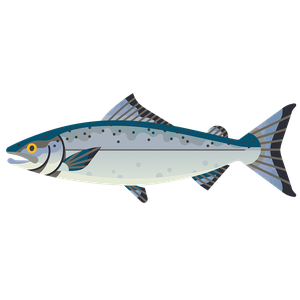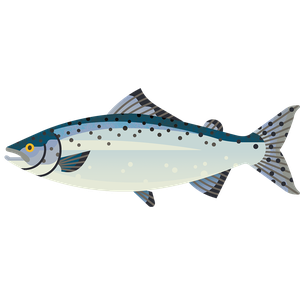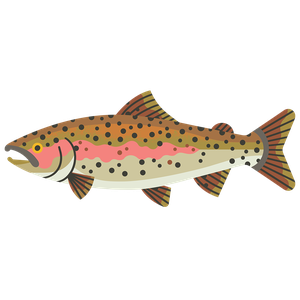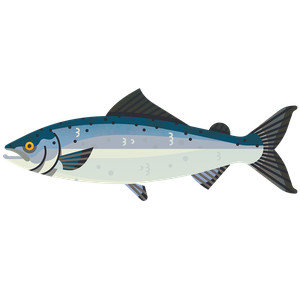
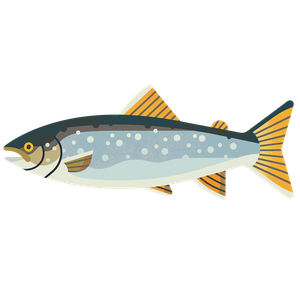
Atlantic salmon
Salmo salar
What to check for
Location
Location
Location refers to two things:
- Where the fish population or stock lives, e.g., North Sea, or South Pacific.
- Who is managing the fishery. If it says “All areas”, this means that our scoring for management covers the same area as the fish stock.
NE Atlantic: All areas and all rivers not achieving conservation limits
Technical location
Technical location
A global system is used to split the ocean into different zones, areas, and subdivisions. Each zone is indicated by a number and/or letter. By law, this must be shown on all unprocessed seafood sold in the EU and UK, alongside the fishing method used to catch it. Look for these details on the packet to match your seafood to our ratings.
All areas
Caught by
Caught by
Net (drift)
Driftnetting uses a net, suspended in the water, that drifts with the current. It is kept vertical by buoys, to create a wall of netting that fish swim into and become entangled. The mesh size and length of time the nets are left at sea varies, depending on where they are fishing and what they are targeting.
Net (gill or fixed)
Gillnetting uses a net, suspended in the water, that is anchored to the seabed. It is kept vertical by buoys, to create a wall of netting that fish swim into and become entangled. The mesh size and length of time the nets are left at sea varies, depending on where they are fishing and what they are targeting.
Net (drift), Net (gill or fixed)
Rating summary
Wild Atlantic salmon stocks across the North Atlantic remain at historically low levels. This is despite restrictive management measures and reductions in fisheries and exploitation rates. Due to the Atlantic salmons oceanic migrations, international cooperation is essential to its conservation, restoration and rational management. ICES advises that when the MSY approach is applied, fishing should only take place on salmon from rivers where stocks have been shown to be at full reproductive capacity. High seas and coastal drift netting captures large numbers of fish as they return to rivers to spawn.
Rating last updated June 2023.
How we worked out this Rating
Stock status
The size and health of a fish population, or 'stock', that is being targeted by fishermen is a crucial indicator of whether a fishery is sustainable. If the stock is too small to withstand fishing, it is at risk of crashing. We look at how big the stock is, and how much pressure there is from fishing, to assess this. The target level that many fisheries aim for is 'Maximum Sustainable Yield' - the most fish that can be caught year after year whilst keeping the population at a healthy size.
Wild Atlantic salmon populations are at historically low levels and scientific advice recommends that no catch takes place.
Despite restrictive management measures and reductions in exploitation rates, salmon stocks across the Northeast Atlantic remain at historically low levels. ICES recommends that fishing for salmon only takes place in rivers where stocks have been shown to be at full reproductive capacity i.e. above conservation limits (CLs). Atlantic salmon is also listed by OSPAR as a threatened and declining species.
Exploitation rates on Northeast Atlantic stocks continue to decline and catches in 2022 were 568 tonnes. This was a reduction from recent years and both 2021 (487 tonnes) and 2022 were notably lower than the preceding years and below the previous 5 year average (897 tonnes, 2016-2020) and 10 year average (1027 tonnes, 2011-2020). The 2021 total catch in the Northeast Atlantic area was the lowest in the time-series. The reported catch do not include salmon that have been caught and released (these are reported separately).
In addition to fishing, the decline in salmon stocks is also attributed to freshwater habitat deterioration and impediments (e.g. dams) to upstream movements. Fishing pressure on wild stocks has decreased due to intensive farming of salmon and worldwide production of farmed salmon is over 1000 times the reported catch of Atlantic salmon in the Northeast Atlantic, but other problems have increased such as disease spread. Climatic factors modifying ecosystem conditions and impact of predators of salmon at sea are also considered to be contributory factors to low productivity of wild salmon.
Management
Good management is vital to be sure that fishing doesn't cause fish populations to decline. We look at whether regulations follow the best available scientific advice, how well compliance is monitored and enforced, and whether this is effective in maintaining healthy fish stocks.
Salmon are managed by a variety of measures which may differ by country. Salmon conservation is coordinated by NASCO.
Due to the Atlantic salmon's oceanic migrations, international cooperation is essential to its conservation, restoration and rational management. The forum for such cooperation is provided by the North Atlantic Salmon Conservation Organization (NASCO). NASCO is an intergovernmental organization that works to conserve and manage Atlantic salmon throughout its range. It facilitates cooperation among countries with salmon stocks in the Northeast Atlantic, develops conservation measures, and promotes research and monitoring.
Under NASCO's Convention, fishing for salmon is prohibited beyond 12 nautical miles of the baselines in most parts of the North Atlantic Ocean, thereby creating an enormous protected zone free of directed salmon fisheries. NASCO has established regulatory measures or decisions for the distant-water fisheries at West Greenland and around the Faroe Islands in most years since its establishment. The International Council for the Exploration of the Sea (ICES) has provided scientific advice to NASCO since its establishment in 1984. This advice indicates that there has been a marked decline in abundance prior to any fisheries, and while marine survival indices in the North Atlantic have improved in some index stocks in recent years, the declining trend has persisted and survival indices remain low.
Each country in the Northeast Atlantic is also responsible for implementing and enforcing regulations within their respective jurisdictions. These authorities set fishing quotas, establish fishing seasons, and enforce regulations to protect salmon stocks. Specific regulations differ between countries but often include closed seasons, catch and release requirements, or gear limitations.
Factors other than marine fisheries, acting in freshwater and in the ocean (e.g. marine mortality, fish passage, water quality) are also contributing to continued low abundance of wild Atlantic salmon. In response to the declining abundance, there have been major reductions in fishing effort around the North Atlantic. In 2001, NASCO established the International Atlantic Salmon Research Board (IASRB) to promote collaboration and co-operation on research into the causes of marine mortality of Atlantic salmon and the opportunities to counteract it. The Board developed and implemented, through a public-private partnership, an innovative and comprehensive programme of marine research, the SALSEA Programme, investigating the distribution and migration of salmon at sea and is currently reviewing the need for further research to partition marine mortality at different stages along the migration route (see www.nasco.int/sas).
Capture method
Environmental impacts of fishing vary hugely, depending on the method used and where it's happening. We look at whether the fishing gear being used could have an effect on seabed habitats, and if so, how severe might this be. We also review whether it catches any other species by accident (bycatch), and what effect this might have on those species - especially if they're Endangered, Threatened, or Protected.
There is limited knowledge on the impacts of salmon fishing on the environment and wider ecosystem.
Wild Atlantic salmon can be harvested in a range of gears, including set and drifting gill nets, various traps and rod and line. High seas and coastal drift netting takes large numbers of fish as they return to rivers to spawn.
Salmon fisheries are thought to have only minor impact on the marine ecosystem. However, the exploitation of salmon in freshwater may affect the riverine ecosystem through changes in species composition but there is limited knowledge on the magnitude of these effects.
References
ICES. 2023. North Atlantic salmon stocks. In Report of the ICES Advisory Committee, 2023. ICES Advice 2023, sal.oth.all. Available at https://doi.org/10.17895/ices.advice.22699276 [Accessed on 20.06.2023].
ICES. 2023. Working Group on North Atlantic Salmon (WGNAS). ICES Scientific Reports. 5:41. 478 pp. Available at https://doi.org/10.17895/ices.pub.22743713 [Accessed on 20.06.2023].
ICES. 2023. Atlantic salmon at West Greenland. In Report of the ICES Advisory Committee, 2023. ICES Advice 2023, sal.wgc.all. https://doi.org/10.17895/ices.advice.22699288 [Accessed on 20.06.2023].
NASCO. Salmon at sea. Available at https://salmonatsea.com/ [Accessed on 20.06.2023].
NASCO. NASCO Implementation Plan for the period 2019-2024. Available at https://www2.gov.scot/Resource/0054/00546369.pdf [Accessed on 20.06.2023].
Myrvold, K.M., Mawle, G. W., Andersen, O. & Aas, Ø. 2019. The Social, Economic and Cultural values of wild Atlantic salmon. A review of literature for the period 2009-2019 and an assessment of changes in values. NINA Report 1668. Norwegian Institute for Nature Research. Available at https://brage.nina.no/nina-xmlui/handle/11250/2627172?locale-attribute=no [Accessed on 20.06.2023].
Sustainable swaps
Learn more about how we calculate our sustainability ratings.
How our ratings work
Add impact to your inbox
Join the movement: get updates on the issues you care about.
We'll email you inspiring stories about the work we're doing to save and recover our oceans, and news about our urgent campaigns for positive change.