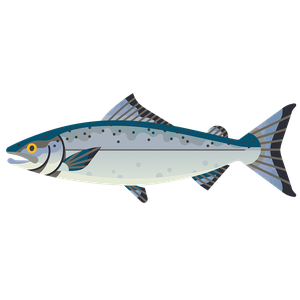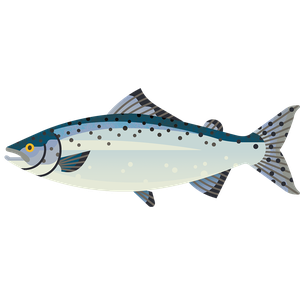
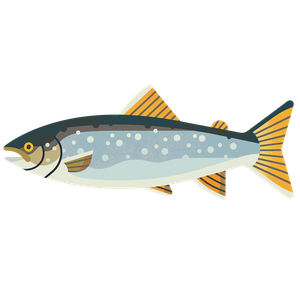
Atlantic salmon
Salmo salar
What to check for
Location
Location
Location refers to two things:
- Where the fish population or stock lives, e.g., North Sea, or South Pacific.
- Who is managing the fishery. If it says “All areas”, this means that our scoring for management covers the same area as the fish stock.
NE Atlantic (England and Wales): All rivers not classified as 'Not at risk' by the Environment Agency
Technical location
Technical location
A global system is used to split the ocean into different zones, areas, and subdivisions. Each zone is indicated by a number and/or letter. By law, this must be shown on all unprocessed seafood sold in the EU and UK, alongside the fishing method used to catch it. Look for these details on the packet to match your seafood to our ratings.
All areas
Caught by
Caught by
Net (drift)
Driftnetting uses a net, suspended in the water, that drifts with the current. It is kept vertical by buoys, to create a wall of netting that fish swim into and become entangled. The mesh size and length of time the nets are left at sea varies, depending on where they are fishing and what they are targeting.
Net (gill or fixed)
Gillnetting uses a net, suspended in the water, that is anchored to the seabed. It is kept vertical by buoys, to create a wall of netting that fish swim into and become entangled. The mesh size and length of time the nets are left at sea varies, depending on where they are fishing and what they are targeting.
Net (drift), Net (gill or fixed)
Rating summary
Wild Atlantic salmon stocks are depleted over much of their range. The status of individual river stocks in England and Wales is evaluated annually against stock conservation limits (CLs) and management targets (MTs) in line with the requirements of ICES and NASCO. In 2022, just 16% rivers were assessed as meeting their CL, joint lowest in the time series. ICES advises that when the MSY approach is applied, fishing should only take place on salmon from rivers where stocks have been shown to be at full reproductive capacity. Regulatory provisions approved for England in 2018 include the closure of most net fisheries including all driftnet fisheries and mandatory release of salmon caught in net fisheries authorised to operate for sea trout.
This rating applies to all rivers not classified as 'Not at risk' by the [Environment Agency](https://www.gov.uk/government/publications/fisheries-annual-report-2021-to-2022).
Rating last updated June 2023.
How we worked out this Rating
Stock status
The size and health of a fish population, or 'stock', that is being targeted by fishermen is a crucial indicator of whether a fishery is sustainable. If the stock is too small to withstand fishing, it is at risk of crashing. We look at how big the stock is, and how much pressure there is from fishing, to assess this. The target level that many fisheries aim for is 'Maximum Sustainable Yield' - the most fish that can be caught year after year whilst keeping the population at a healthy size.
Wild Atlantic salmon populations are at historically low levels and scientific advice recommends that no catch takes place.
Information and data on the status of salmon stocks in England and Wales is compiled by the Centre for Environment, Fisheries and Aquaculture Science (Cefas), the Environment Agency and Natural Resources Wales (NRW). There are 49 rivers in England and 31 rivers in Wales that regularly support salmon, although some of the stocks are very small and support minimal catches. Of these, 64 have been designated 'principal salmon rivers'.
Conservation limits (CLs) and management targets have been set for the 64 principal salmon rivers and are used to give annual advice on stock status and to assess the need for management and conservation measures. Returning stock estimates and counts for rivers in 2021 were below the values recorded in 2020, with estimated returns being the lowest in the time series for one river. Overall, there has been a marked decline in the numbers of returns to most rivers over the last decade, particularly in the South West, Wales, and North West. However, for a number of rivers in southern England, there is evidence of stocks stabilising and showing signs of recovery.
Egg deposition levels in 2021 were estimated to be above the CL on 10 of the 64 principal salmon rivers in England and Wales (16% of all rivers), which is the joint lowest in the 29-year time series. Rivers where egg deposition levels were below the CL were widely distributed across England and Wales.
Formal compliance assessment in the current year (2021) classified 1 river as ‘not at risk’ (>95% probability of achieving the management objective or MO – namely to meet or exceed the CL in at least 4 years out of 5, on average), 4 rivers (6%) as ‘probably not at risk’ (50-94% probability of achieving the MO), 8 rivers (13%) as ‘probably at risk’ (5- 49% probability of achieving the MO), and 51 rivers (80%) as ‘at risk’ (<5% probability of achieving the MO) which is the highest in the time series.
Fishing pressure is thought to have decreased as new regulatory provisions in England (2019) and Wales (2020) have substantially reduced the retention of salmon in 2021. The measures included the closure of many net fisheries and mandatory catch and release in others. In many rod fisheries, there were increased levels of catch and release, some mandatory and others voluntary, although further progress still needs to be made on some river catchments.
ICES recommends that when the MSY approach is applied, fishing for salmon only takes place in rivers where stocks are known to be above CLs and at full reproductive capacity.
Management
Good management is vital to be sure that fishing doesn't cause fish populations to decline. We look at whether regulations follow the best available scientific advice, how well compliance is monitored and enforced, and whether this is effective in maintaining healthy fish stocks.
Wild salmon in England and Wales are managed by the Environment Agency and Natural Resources Wales, respectively. There are a variety of management measures in place, including catch and release and closed seasons.
Due to the Atlantic salmon's oceanic migrations, international cooperation is essential to its conservation, restoration and rational management. The forum for such cooperation is provided by the North Atlantic Salmon Conservation Organization (NASCO). Under NASCO's Convention, fishing for salmon is prohibited beyond 12 nautical miles of the baselines in most parts of the North Atlantic Ocean, thereby creating an enormous protected zone free of directed salmon fisheries. ICES has provided advice to NASCO on salmon stocks since it was established in 1983. Despite management measures aimed at reducing exploitation in recent years, there has been little improvement in the status of stocks over time.
In England and Wales salmon stocks are managed on a river by river basis by the Environment Agency and Natural Resources Wales respectively. The importance of managing salmon on such a basis is emphasised by the fact salmon from different rivers, and even from different parts of the same river system, are genetically distinct. Fisheries are primarily regulated by effort controls, which specify the nature of the gear that may be operated, along with where, when and how it may be used. Anyone fishing for salmon with nets, traps or rod and line must have a license, and numbers of net/trap licenses issued are usually limited by Net Limitation Orders (NLOs) that apply to individual fisheries (e.g. within each estuary). Byelaws may be introduced to make reductions in fishing effort in rod and net fisheries (e.g. length of seasons, to control the type of fishing gear that may be used, or where and when fishing may take place). Where there is a justified and serious conservation concern, byelaws can be used to close fisheries. While, historically, there have been no regulations imposing catch limits for salmon net fisheries (with regulation focusing only on effort controls), there has been limited use of catch limits in recent years.
Since 1996, there has been a policy in England and Wales to close coastal net fisheries that exploit predominantly mixed stocks where capacity to manage individual stocks is compromised. Drift netting for salmon and sea trout should have ended by 2022. T&J (type of fixed net) nets that are exploiting salmon from rivers of unknown origin, where populations within their stocks may be below conservation levels (CLs) are also being phased out. National spring salmon byelaws introduced in 1999 prohibit killing, and in most cases fishing for, salmon before 1 June. As well as statutory measures, a range of voluntary measures is in place. These include agreements between angling and netting interests, which result in netsmen being compensated to release fish or not to fish, and extensive voluntary catch and release (C&R) of rod-caught fish. A national byelaw came into effect in England and Wales in 2009 requiring all net-caught salmon and sea trout to be individually tagged with a carcass tag after capture and for the details of all fish caught to be recorded in an annual logbook. A national byelaw banning the sale of rod-caught salmon and sea trout in England and Wales also came into effect in 2009.
Regulatory provisions approved in England in December 2018 substantially reduced the exploitation of salmon since 2019. These measures include the closure of many net fisheries and mandatory C&R in others. In many rod fisheries, there were increased levels of C&R, some mandatory and other voluntary. Mandatory C&R of salmon in all net and rod fisheries will applied in Wales from 2020.
Capture method
Environmental impacts of fishing vary hugely, depending on the method used and where it's happening. We look at whether the fishing gear being used could have an effect on seabed habitats, and if so, how severe might this be. We also review whether it catches any other species by accident (bycatch), and what effect this might have on those species - especially if they're Endangered, Threatened, or Protected.
There is limited knowledge on the impacts of salmon fishing on the environment and wider ecosystem.
There are many different specialised salmon fishing methods employed in England and Wales. These can be grouped into 5 generic categories: gill nets (which entangle fish), sweep nets (which encircle and trap fish), hand-held nets, fixed engines (a term used to describe various fixed fishing gears) and rods. Anyone fishing for salmon with a net, fixed engine or rod must have a licence. The number of licences issued is limited by Net Limitation Orders (NLOs). NLOs do not however apply to privately owned fisheries which may be regulated by bylaws. There is no limit to the number of rod licences that can be issued.
Drift net and beach net fisheries for salmon are being phased out because these fisheries exploit fish from more than one river, making it impossible to regulate the level of exploitation on individual river stocks. A national byelaw came into effect in England and Wales in 2009 requiring all net-caught salmon and sea trout to be individually tagged with a carcass tag after capture and for the details of all fish caught to be recorded in an annual logbook. This measure, in tandem with a ban on sale of rod-caught fish, was designed to reduce the sale of illegally caught fish.
Salmon fisheries are thought to have only minor impact on the marine ecosystem. However, the exploitation of salmon in freshwater may affect the riverine ecosystem through changes in species composition but there is limited knowledge on the magnitude of these effects.
References
Cefas, EA and NRW. 2021. Salmon Stocks and Fisheries in England and Wales in 2021. Available at https://assets.publishing.service.gov.uk/government/uploads/system/uploads/attachment_data/file/1093963/SalmonReport-2021-assessment.pdf [Accessed on 20.06.2023].
ICES. 2023. North Atlantic salmon stocks. In Report of the ICES Advisory Committee, 2023. ICES Advice 2023, sal.oth.all. Available at https://doi.org/10.17895/ices.advice.22699276 [Accessed on 20.06.2023].
ICES. 2023. Working Group on North Atlantic Salmon (WGNAS). ICES Scientific Reports. 5:41. 478 pp. Available at https://doi.org/10.17895/ices.pub.22743713 [Accessed on 20.06.2023].
NASCO. Salmon at sea. Available at https://salmonatsea.com/ [Accessed on 20.06.2023].
NASCO. NASCO Implementation Plan for the period 2019-2024. Available at https://www2.gov.scot/Resource/0054/00546369.pdf [Accessed on 20.06.2023].
Myrvold, K.M., Mawle, G. W., Andersen, O. & Aas, Ø. 2019. The Social, Economic and Cultural values of wild Atlantic salmon. A review of literature for the period 2009-2019 and an assessment of changes in values. NINA Report 1668. Norwegian Institute for Nature Research. Available at https://brage.nina.no/nina-xmlui/handle/11250/2627172?locale-attribute=no [Accessed on 20.06.2023].
Windsor, M.L., Hutchinson, P., Hansen, L.P. and Reddin, D.G. 2012. Atlantic salmon at sea: Findings from recent research and their implications for management. NASCO document CNL(12)60. Edinburgh, UK. 20pp. Available at http://www.nasco.int/sas/pdf/archive/other_reports/Salmon_at_sea.pdf [Accessed on 20.06.2023].
Sustainable swaps
Learn more about how we calculate our sustainability ratings.
How our ratings work
Add impact to your inbox
Join the movement: get updates on the issues you care about.
We'll email you inspiring stories about the work we're doing to save and recover our oceans, and news about our urgent campaigns for positive change.