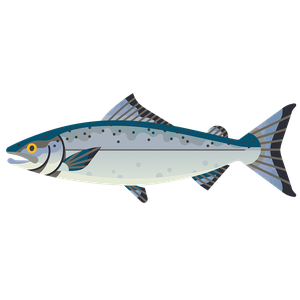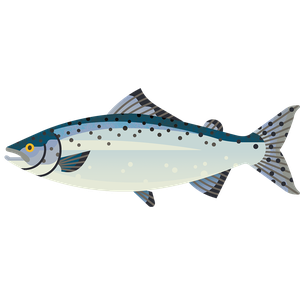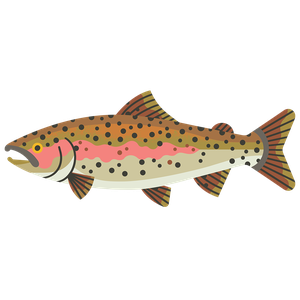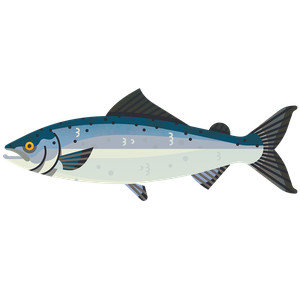
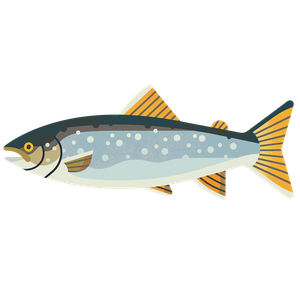
Atlantic salmon
Salmo salar
What to check for
Location
Location
The location for farmed fish can refer to a region or country, or it can be global. We do not provide ratings at individual farm level. We rate farmed fish produced in a distinct area, using the same production method in the same environment. Sometimes, especially when looking at certified farmed fish, how they are produced and managed is the same the world over, so the rating applies globally.
South America: Chile, All areas
Production method
Open net pen, marine
Open net pen means the fish are contained in a pen that is open to the surrounding water. The pens are constructed from a strong net suspended off either a plastic tube structure or a metal frame. The open nature of this production allows the surrounding water to flow through to bringing oxygen and dispersing waste.Open net pen, marine
Rating summary
Atlantic salmon is Chile are farmed in open net pens in the sea. Producing fish in open systems can cause environmental impacts such as: impacts of chemical and sea lice treatment usage; nutrient and organic waste deposition; outbreaks of disease; impacts on wild salmonids by transmission of sea lice, and escapes from farms. In Chile, the regulation and management of the aquaculture industry is poor in relation to other salmon producing countries. There is also a lack of evidence of welfare measures in place. Salmon are carnivorous fish and rely on wild capture fisheries to produce their feed, MCS would like to see all these fish certified as sustainably managed. Due to the ongoing nature of as yet unresolved environmental impacts of salmon farming MCS is advocating a halt in industry expansion using existing practices until these can be resolved.
Rating last updated May 2023.
How we worked out this Rating
Feed
What feed is given to farmed fish, where it comes from and how much is used is one of the most important aspects of fish farming. In this section we look at how sustainable the feed is and how much fish is included in the diet.
Feed used in Chilean salmon aquaculture is traceable and requirements are in place for responsible ingredient souring. However, salmon is a net consumer of fish protein.
The production of Chilean Atlantic salmon relies on a variety of different feeds including specialist formulation. It is thought that four main feed producers dominate in Chile: Nutreco's Skretting, Cargill EWOS, Biomar and local company SalmoFood. These are all privately owned and the market share of each in Chile is not public information. All these companies have policies in place to ensure the traceability of ingredients.
The majority of feed producers have policies in place that ensure the responsible sourcing of the majority of marine wild capture protein and oil sources and this can be independently verified (MarinTrust). The dependency of wild caught fish used in fish meal and fish oil (known as the Feed Fish Dependency Ratio) for this species currently indicates that more fish protein is required in the diet than these fish produce, making them a net consumer of fish rather than a fish producer. The majority of feed producers also have policies in place that ensure the responsible sourcing of soy and palm oil.
Environment
The environmental impacts of aquaculture depend on what fish is farmed, how and where. It could be habitat damage, chemical use, pollution, freshwater use or parasites. In this section we look at the environmental impacts of greatest concern for that species and production method. Some species, such as shellfish, have very little impact, whilst others may give us cause for concern.
Salmon farming in marine open net pens has a negative impact on the environment.
The environmental impacts of Chilean salmon farming are different to other producing countries as Atlantic salmon is not native to Chile. Habitat alteration is small scale through the use of mooring grids only and does not impact ecosystem functionality. All juveniles used in salmon aquaculture in Chile come from hatcheries, and cleaner fish are not widely used.
All salmon farms in Chile rely on chemical usage. Fish farms use a range of medicines and products containing chemicals, such as disinfectants and antifoulants to ensure the health and welfare of the fish they grow and to maintain and protect the farm infrastructure and equipment (e.g. pens and boats). Chile has one of the highest rates of antibiotic use in salmon production in the world. There are no regulatory limits on the frequency or total quantity of antibiotics used should a disease outbreak occur, but various initiatives are underway to attempt to address the problem. There are also no limits on pesticide use, in terms of frequency or total dose. Total nutrient discharges from salmon farms in Chile appear large. At the site level, the monitoring of soluble nutrient effluents in the water column is not mandated in the regulations and it is thought that the regulatory framework is ineffective.
Chilean aquaculture has a problem with both pathogens and parasites. In particular, the pathogen Piscririckettsia salmonis and the sea lice parasite, Caligus rogercresseyi. However, the impact of pathogens or parasites on wild fish populations is unknown. There is a risk of escapes of farmed salmon, however, as Atlantic salmon are not native to Chile and evidence suggests that escapes are not able to establish themselves, there is limited environmental impact. There is potential interactions between farmed salmon and sea lice, however, this is not thought to include lethal control with predator nets being the main mitigation strategy.
Fish health and welfare
Fish health and welfare is a concern for many consumers. High welfare standards are an indication of good farm management, we look to see if there are industry wide welfare standards in place, and if these include humane slaughter.
In Chile, Atlantic salmon are slaughtered by percussive stunning, mainly at land based processing plants. The extent of welfare practices in place is unknown.
Management
How aquaculture is regulated and how effective those regulations are is an important aspect of farmed fish production. We also look to see if aquaculture is included in broader environmental management plans. In this management section we also award scores for globally recognised certification standards, as certified seafood requires verification of environmental performance and traceability.
Management of salmon aquaculture in Chile is okay but farms would benefit from third party certification.
In Chile, the administration of marine conservation is complex, with multiple state agencies having the power to establish, veto, and administer the governance and management of ocean and coastal resources. At present, there is no strategic environmental planning in place, however, this could be subject to change in the future as Chile has been active over the past 5 years in designating MPAs in its marine waters and this is often a precursor to the development of a plan to cover all national marine waters.
In Chile, there is regulatory framework in place to address farm level environmental impact assessment, protection of valuable habitats and species, use of land and water resources, discharges, biosecurity and disease management. However, it is thought that regulation is not effective. Chile has widespread problems with both parasites and pathogens in salmon farms. Regulations regarding the use of chemicals, discharges and escapes are also thought to be ineffective.
References
BioMar, 2022. Global Sustainability Report. Available at https://www.biomar.com/globalassets/.global/sustainability-report/biomar-global-sustainability-report-2022.pdf [Accessed on 28.04.2023].
BioMar, 2022. Marine Ingredients Position Statement. Available at https://www.biomar.com/globalassets/.global/pdf-files/2022-03-en_position-statement_marine-ingredients_ver.1_digital.pdf [Accessed on 01.11.2022].
Cargill, 2021. Cargill Aqua Nutrition Sustainability Report. Available at: https://www.cargill.com/doc/1432219325606/cargill-aqua-nutrition-sustainability-report-2021.pdf [Accessed on 01.11.2022].
Charles Ehler, personal communication via email, 26.08.2019.
FAO. Chile. Available at https://firms.fao.org/fi/website/FIRetrieveAction.do?dom=countrysector&xml=naso_chile.xml&lang=en [Accessed on 28.04.2023].
Intrafish. 2019. Here are the largest recorded farmed Atlantic salmon escapes in history. Available at https://www.intrafish.com/aquaculture/here-are-the-largest-recorded-farmed-atlantic-salmon-escapes-in-history/2-1-388082 [Accessed on 15.04.2020].
Monterey Bay Aquarium Seafood Watch. 2021. Atlantic and Coho Salmon. Chile. Marine Net Pens. Available at https://www.seafoodwatch.org/globalassets/sfw-data-blocks/reports/s/mba_seafoodwatch_atlantic_coho_salmon_chile.pdf [Accessed on 28.04.2023].
OECD. 2011. - Chile going green- , in Maintaining Momentum: OECD Perspectives on Policy Challenges in Chile, OECD Publishing, Paris. Available at https://www.oecd-ilibrary.org/economics/maintaining-momentum/chile-going-green_9789264095199-11-en;jsessionid=cd7x4FtNd-hdqANOV4gQCHZCBDtMAQOPpIkIBHID.ip-10-240-5-186 [Accessed on 15.05.2023].
Quinones, R. A., Fuentes, M., Montes, R. M., Soto, D. and Leon-Munoz, J. 2019. Environmental issues in Chilean salmon farming: a review. Reviews in Aquaculture, 11(375-402). Available at https://onlinelibrary.wiley.com/doi/pdf/10.1111/raq.12337 [Accessed on 15.05.2023].
Skretting. 2019. Sustainability Report. Available at https://www.skretting.com/siteassets/global-files/nuterra/sustainability-report-2019/skretting-sustainability-report-2019.pdf [Accessed on 09.09.2020].
Skretting. 2020. Sustainable soy. Available at https://www.skretting.com/en/sustainability/ingredients/sustainable-soy/ [Accessed on 12.02.2020].
Skretting. 2020. Sustainable soy. Available at https://www.skretting.com/en/sustainability/ingredients/sustainable-soy/ [Accessed on 13.04.2020].
The David & Lucile Packard Foundation. 2019. Chile Marine Strategy 2019-2021. Available at https://www.packard.org/wp-content/uploads/2019/01/Chile-Marine-Strategy-2019-2021-02.19.pdf [Accessed: 26.08.2019].
Undercurrent News. 2020. Cargill to win Chile market share with settlements over feed price-fixing. Available at https://www.undercurrentnews.com/2020/02/13/cargill-to-win-chile-market-share-with-settlements-over-feed-price-fixing/ [Accessed on 13.04.2020].
Sustainable swaps
Learn more about how we calculate our sustainability ratings.
How our ratings work
Add impact to your inbox
Join the movement: get updates on the issues you care about.
We'll email you inspiring stories about the work we're doing to save and recover our oceans, and news about our urgent campaigns for positive change.