
Porcelain crabs
Porcellanidae
IUCN Status:Not Evaluated
These delicate looking crustaceans are actually masters of survival, hiding among rocks and coral snatching tiny morsels from passing currents.
What do they look like?
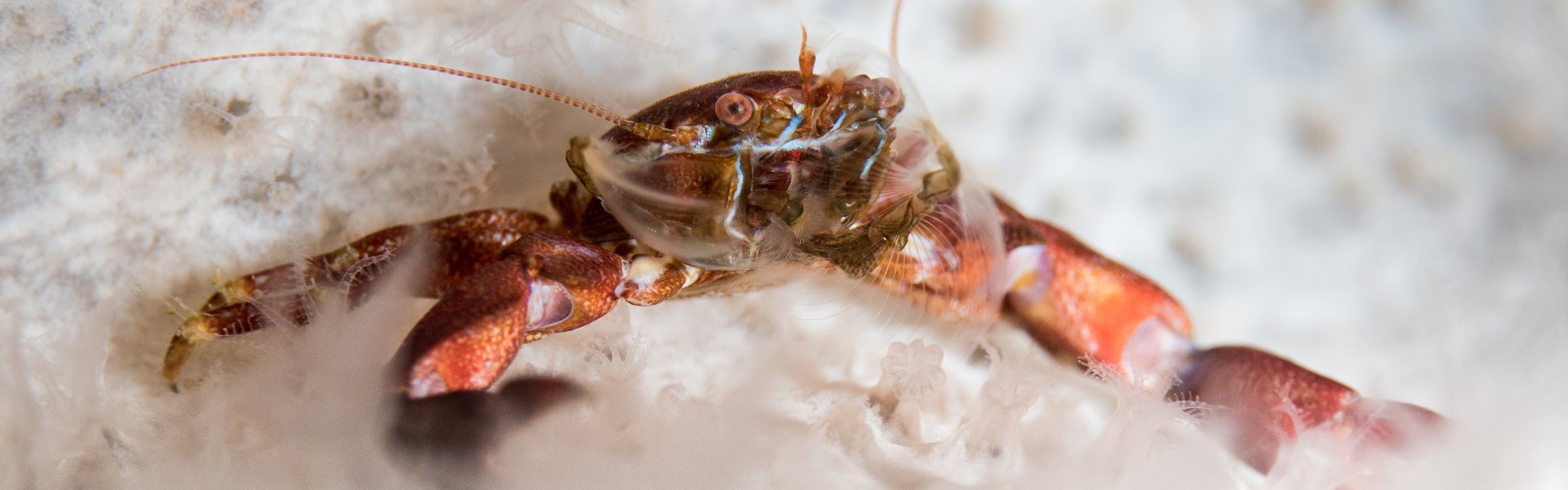
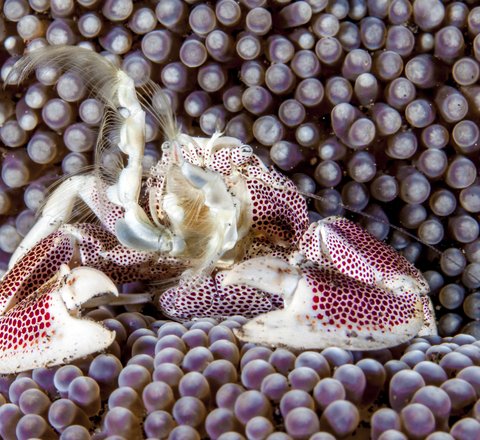
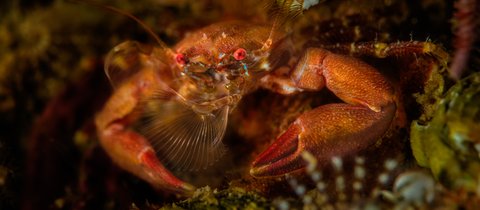
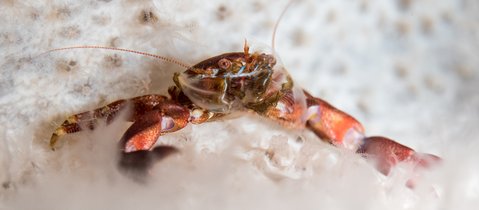
Porcelain crabs have flattened, compact bodies, oversized claws and long antennae that give them the appearance of tiny crabs. However, their most distinctive feature is a pair of feathery, fan-like mouthparts that they use to filter plankton from the water. Depending on the species, porcelain crabs can be brightly coloured, spotted, striped or almost perfectly camouflaged against rocks, corals and sea anemones. Their smooth, delicate shells are what earned them the name "porcelain" crab.
Where can they be found?
Porcelain crabs are found across the world, from tropical coral reefs to temperate rocky coastlines. They're only absent only from the Arctic and Antarctic ocean. The UK is home to several porcelain crab species, but the broad-clawed porcelain crab is a common sight on British rocky shores, where it hides beneath stones and filters microscopic food from the water.
Did you know... Porcelain crabs are such a diverse group that scientists are still discovering new species today. In fact, as recently as 2026, researchers identified a brand-new porcelain crab hidden among India's coral reefs.
Key facts
Porcelain crabs aren't actually true crabs. Instead, they belong to a group more closely related to squat lobsters and hermit crabs, making them a fascinating example of different animals evolving a crab-like body shape. There are estimated to be more than 4,000 species of porcelain crab found all around the world, ranging from tiny reef-dwellers to larger species that live beneath rocky shores.
Despite their sturdy-looking claws, porcelain crabs are surprisingly delicate. They will often shed limbs to escape predators and then regrow lost legs and claws over multiple moults. Their flattened bodies often allow them to squeeze into narrow spaces beneath rocks and corals, which helps them avoid predators. Other species live alongside sea anemones and other marine animals, gaining protection while helping to keep their host clean by removing food particles and debris from the water.
Although their oversized claws may look useful for catching prey, porcelain crabs use them mainly for intimidation and fighting for territory against other porcelain crabs. They don't actually need claws to catch their food as they're filter feeders. Using them to catch plankton would be like using a fork to eat soup. Instead, it uses delicate, fan-like mouthparts to filter in plankton from the water.
| Also known as | Fan crab |
|---|---|
| IUCN status | Not Evaluated |
| Length | Porcelain crabs vary in size hugely between species. The smallest can be less than 1cm across, while larger species can reach approximately 5cm. |
| Weight | The majority of porcelain crabs weigh just a few grams. The smallest species weigh less than a paperclip, while even the largest will rarely exceed 10g - less than a tablespoon of sugar! |
| Diet | Most porcelain crabs are filter feeders, catching plankton and other tiny food particles from the water. Some species also supplement their diet by scavenging or collecting organic matter from rocks and the seabed too. |
| Speed and distance | They're rather slow-moving crustaceans that rarely travel far from their shelter. Most species spend their lives within a small home range, hiding in crevices, under rocks or among sea anemones and will only venture out short distances to feed. |
| Habitat | Different species occupy different habitats, including rocky crevices, coral rubble, sea anemones, sponges and even the shells inhabited by hermit crabs. |
| Lifespan | They usually live around 2-5 years for many species. Like other crustaceans, porcelain crabs will grow by moulting and emerging from their old shell before hardening a new one. |
Support our blue planet
The ocean is home to an extraordinary diversity of life, but it faces growing threats from climate change, human activity, habitat destruction and pollution. Your support helps fund vital science-based conservation, research, and restoration projects that make a real difference.