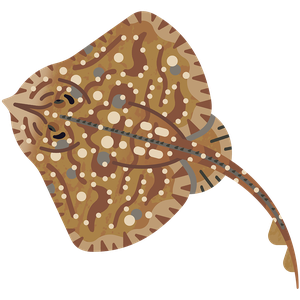
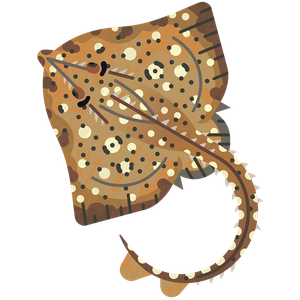
Flapper skate
Dipturus intermedius
What to check for
Location
Location
Location refers to two things:
- Where the fish population or stock lives, e.g., North Sea, or South Pacific.
- Who is managing the fishery. If it says “All areas”, this means that our scoring for management covers the same area as the fish stock.
North Sea and Skagerrak; Celtic Sea and West of Scotland: All areas
Technical location
Technical location
A global system is used to split the ocean into different zones, areas, and subdivisions. Each zone is indicated by a number and/or letter. By law, this must be shown on all unprocessed seafood sold in the EU and UK, alongside the fishing method used to catch it. Look for these details on the packet to match your seafood to our ratings.
7: Irish Sea, Porcupine Bank, English Channel, Bristol Channel, Celtic Seas, West and Southwest of Ireland, 6: Rockall, West of Scotland
Caught by
Caught by
Bottom trawl (beam)
Beam trawling involves towing a net over the seabed. The net is held open by a heavy beam. There can be tickler chains or chain matting, which drag along the front of the net. They disturb the fish, causing them to swim up and into the net, which is then hauled onto the boat.
Bottom trawl (otter)
Otter trawling involves towing a net over the seabed. The net is held open by two panels, known as otter boards. Fish are herded between the boards and into the net, which is then hauled onto the boat.
Net (gill or fixed)
Gillnetting uses a net, suspended in the water, that is anchored to the seabed. It is kept vertical by buoys, to create a wall of netting that fish swim into and become entangled. The mesh size and length of time the nets are left at sea varies, depending on where they are fishing and what they are targeting.
Bottom trawl (beam), Bottom trawl (otter), Net (gill or fixed)
Rating summary
It is prohibited to fish for, land, or retain blue and flapper skate in UK or EU waters. Very little is know about the stock, but both species are assessed as Critically Endangered by IUCN and are listed by OSPAR as a threatened and declining species. Therefore, they are automatically a red-rated species.
Rating last updated October 2023.
How we worked out this Rating
Stock status
The size and health of a fish population, or 'stock', that is being targeted by fishermen is a crucial indicator of whether a fishery is sustainable. If the stock is too small to withstand fishing, it is at risk of crashing. We look at how big the stock is, and how much pressure there is from fishing, to assess this. The target level that many fisheries aim for is 'Maximum Sustainable Yield' - the most fish that can be caught year after year whilst keeping the population at a healthy size.
There is zero catch advice for both blue and flapper skate and it is prohibited to catch them across this area of Europe.
Blue skate and flapper skate are assessed together by ICES as the common skate or Dipterus spp. complex. Due to the lack of data collected for each species, there are no robust indicators to determine the population trends. There are no reference points for biomass, however, fishery surveys have shown an increased number of individuals caught. ICES may provide a stock-size indicator in the future. Both flapper and blue skate are assessed as Critically Endangered on the IUCN Red List.
Misidentification is common with all members of the genus in this area (blue skate, flapper skate, Norwegian skate, and longnosed skate). Taxonomic distinction between the two species is improving; however, some misidentification is still observed and reported landings are therefore not informative of species composition or catch.
There has been a marked decline in reported landings of Dipturus spp., the reasons for this are currently unclear to ICES. Current UK and EU regulations prohibit the fishing, retention on board, transshipping, or landing of blue skate and flapper skate. Both species have very low resilience to fishing pressure with minimum population doubling time of more than 14 years. ICES advises that when the precautionary approach is applied, there should be zero catch in each of the years 2023 and 2024.
Discarding is known to take place, but discard survival has not been estimated.
Management
Good management is vital to be sure that fishing doesn't cause fish populations to decline. We look at whether regulations follow the best available scientific advice, how well compliance is monitored and enforced, and whether this is effective in maintaining healthy fish stocks.
It is prohibited to catch blue and flapper skate across this area of Europe. Therefore, it is a critical fail on the Good Fish Guide.
There are a lack of reference points for the stock, which prevents the development of management plans. ICES advises that the collection of species-specific landings data should be introduced for more species of rays and skates to help inform on the status of these stocks. However, species-specific quotas may increase misreporting or discarding.
Current UK and EU regulations prohibit the fishing, retention on board, transshipping, or landing of the common skate complex (blue skate and flapper skate). This prohibition applies to UK and EU waters of ICES Division 2.a and subareas 3-4 and 6-10. The species’ are also on The UK List of Priority Species and Habitats and have been listed as priorities for conservation action under the UK Biodiversity Action Plan (UK BAP). The Plan aims to stabilise populations by minimising fishing mortality and legally protect it in at least 5 key areas. The Loch Sunart to the Sound of Jura Marine Conservation Order lists “common skate” as the designation feature of this MPA which should reduce fishing mortality and maintain habitat in an important area for the species.
Identification of skate and ray species at the point of sale is difficult as they are commercially valued for their wings and so the bodies are often discarded and the wings skinned. However, DNA analysis of skate wings on sale in the UK suggests that blue and flapper skate do not often reach the market. Landings for both flapper and blue skate are reported, however, they are often misidentified and recorded as Norwegian skate or longnosed skate.
The Skate Working Group and OSPAR highlight the need to build on and develop a greater understanding of the species’ current distributions and critical habitat to inform future management options. Additionally, flapper skate may be more vulnerable to overfishing which highlights the need to monitor and assess these two species separately.
Skates and rays caught in the Northwest waters (ICES subareas 6 and 7) and North Sea waters (ICES subareas 2a, 3a and 4) with all fishing gears, are exempt from the landing obligation, based on their high survivability rates. Any skates and rays that are discarded are required to be released immediately and below the sea surface.
Both the EU and UK have fishery management measures in place, which can include catch limits, targets for population sizes and fishing mortality, and controls on what fishing gear can be used and where. In the EU, compliance with regulations has been variable, and there are ongoing challenges with implementing some of them. There was a target for fishing to be at Maximum Sustainable Yield by 2020, but this was not achieved.
In the UK, it is too early to tell how effective management is, as the Fisheries Act only came into force in January 2021. The Act requires the development of Fisheries Management Plans (FMPs) (replacing EU Multi-Annual Plans) but there are no details yet on how and when these will be developed. FMPs have the potential to be very important tools for managing UK fisheries, although data limitations may delay them for some stocks. MCS is keen to see FMPs for all commercially exploited stocks, especially where stocks are depleted, that include:
- Targets for fishing pressure and biomass, and additional management when those targets are not being met
- Timeframes for stock recovery
- Technologies such as Remote Electronic Monitoring (REM) to support data collection and improve transparency and accountability
- Consideration of wider environmental impacts of the fishery
Capture method
Environmental impacts of fishing vary hugely, depending on the method used and where it's happening. We look at whether the fishing gear being used could have an effect on seabed habitats, and if so, how severe might this be. We also review whether it catches any other species by accident (bycatch), and what effect this might have on those species - especially if they're Endangered, Threatened, or Protected.
Blue and flapper skate can be caught using different fishing methods. As this species is a Fish to Avoid, capture method impacts have not been scored.
Blue and flapper skate are found in the Northeast Atlantic, from Iceland to the British Isles, they were formerly more widespread, including the Mediterranean Sea and North Africa, but the range is thought to be reduced due to fishing.
These species are not a target fishery but they can be taken as bycatch in fisheries catching roundfish and flatfish, the quantity of which is not known. Methods of capture can include, but are not limited to:
- beam trawl
- otter trawl
- gill net
- tangle net
All these methods may have bycatch of other vulnerable species, and trawling can have habitat impacts.
The Skate Working Group recommend that methods to reduce incidental catches are tested and implemented, including the removal of tickler chains in trawl fisheries.
References
Dedman, S., Officer, R. Brophy, D., Clarke, M. Reid, D. G. 2017. Towards a flexible Decision Support Tool for MSY-based Marine Protected Area design for skates and rays, ICES, 74 (2) pp. 576-587. Available at https://academic.oup.com/icesjms/article/74/2/576/2669563 [Accessed on 04.10.2023].
Eigaard, O.R., Bastardie, F., Breen, M., Dinesen, G.E., Hintzen, N.T., Laffargue, P., Mortensen, L.O., Nielsen, J.R., Nilsson, H.C., O'Neill, F.G., Polet, H., Reid, D.G., Sala, A., Sköld, M., Smith, C., Sorensen, T.K., Tully, O., Zengin, M., Rijnsdorp, A.D., 2016. Estimating seabed pressure from demersal trawls, seines, and dredges based on gear design and dimensions. ICES Journal of Marine Science, Volume 73, Issue suppl 1. Pages i27-i43. Available at https://academic.oup.com/icesjms/article/73/suppl_1/i27/2573989 [Accessed on 04.10.2023].
Ellis, J.R., McCully-Philipps, S.R., Sims, D., Walls, R.H.L., Cheok, J., Derrick, D., et al., 2021. Dipturus intermedius. The IUCN Red List of Threatened Species 2021: e.T18903491A68783461. Available at https://dx.doi.org/10.2305/IUCN.UK.2021-2.RLTS.T18903491A68783461.en. [Accessed on 11.10.2023].
Ellis J., McCully-Philipps, S.R., Sims, D., Derrick, D., Cheok, J., Dulvy, N.K., 2021. Dipturus batis. The IUCN Red List of Threatened Species 2021: e.T203364219A203375487. Available at https://dx.doi.org/10.2305/IUCN.UK.2021-2.RLTS.T203364219A203375487.en. [Accessed on 11.10.2023].
Ellis, J. R., Burt, G.J., Grilli, G., McCully Phillips, S.R., Catchpole, T.L., Maxwell, D.L. 2018. At-vessel mortality of skates (Rajidae) taken in coastal fisheries and evidence of longer-term survival. Journal of Fish Biology. 92, 1702-1719. Available at https://pubmed.ncbi.nlm.nih.gov/29675895/ [Accessed on 04.10.2023].
Fowler, S., Mogensen, C.B. and Blasdale, T., 2004. Plan of Action for the Conservation and Management of Sharks in UK Waters. JNCC Report No. 360. Available at https://data.jncc.gov.uk/data/1db13bd9-ead2-4b22-a965-99de5de1c457/JNCC-Report-360-FINAL-WEB.pdf [Accessed on 10.10.2023].
Froese, R. and Pauly, D. (Editors), 2023. Blue skate - Dipturus batis. Available at https://www.fishbase.se/Summary/SpeciesSummary.php?ID=2058&AT=blue+skate [Accessed on 11.10.2023].
Froese, R. and Pauly, D. (Editors), 2023. Flapper skate, Dipturus intermedius – Fishbase. Available at https://www.fishbase.se/summary/Dipturus-intermedius.html [Accessed on 11.10.2023].
Frost M, Neat FC, Stirling D, Bendall V, Noble LR, Jones CS., 2020. Distribution and thermal niche of the common skate species complex in the north-east Atlantic. Mar Ecol Prog Ser, 656:65–74.
Garbett A, Phillips ND, Houghton JDR, Prodöhl P, Thorburn J, Loca SL, et al., 2021. The critically endangered flapper skate (Dipturus intermedius): Recommendations from the first flapper skate working group meeting. Mar Policy: 1;124:104367.
Griffiths AM, Sims DW, Cotterell SP, El Nagar A, Ellis JR, Lynghammar A, et al. 2010. Molecular markers reveal spatially segregated cryptic species in a critically endangered fish, the common skate (Dipturus batis). Proc R Soc B Biol Sci 277(1687):1497–503.
Hiddink, J., Jennings, S., Sciberras, M., Szostek, C.L., Hughes, K.M., Ellis, N., Rijnsdorp, A.D., McConnaughey, R.A., Mazor, T., Hilborn, R., Collie, J.S., Pitcher, C.R., Amoroso, R.O., Parma, A.M., Suuronen, P. and Kaiser, M.J. 2017. Global analysis of depletion and recovery of seabed biota after bottom trawling disturbance. PNAS. 114:31, pp. 8301-8306. Available at https://doi.org/10.1073/pnas.1618858114 [Accessed on 04.10.2023].
ICES. 2022. Common skate complex (blue skate [Dipturus batis] and flapper skate [Dipturus intermedius]) in Subarea 6 and divisions 7.a–c and 7.e–k (Celtic Seas and western English Channel). In Report of the ICES Advisory Committee, 2022. ICES Advice 2022, rju.27.67a-ce-k. Available at https://doi.org/10.17895/ices.advice.19754416 [Accessed on 10.11.2023].
ICES. 2022. Working Group on Elasmobranch Fishes(WGEF).ICES Scientific Reports. 4:74. 848pp. Available at http://doi.org/10.17895/ices.pub.21089833 [Accessed on 04.10.2023].
Kennelly, S. J. & Broadhurst, M. K., 2021. A review of bycatch reduction in demersal fish trawls. Rev Fish Biol Fisheries 31, 289–318. Available at https://doi.org/10.1007/s11160-021-09644-0. [Accessed on 04.10.2023].
Kynoch, R., Fryer, R. & Neat, F., 2015. A simple technical measure to reduce bycatch and discard of skates and sharks in mixed-species bottom-trawl fisheries. ICES J Mar Sci,72(6):1861. Available at https://academic.oup.com/icesjms/article/72/6/1861/921176 [Accessed on 04.10.2023].
Mangi, S., Kupschus, S., Mackinson, S., Rodmell, D., Lee, A., Bourke, E., Rossiter, T., Masters, J., Hetherington, S., Catchpole, T. and Righton, D. 2018. Progress in designing and delivering effective fishing industry science data collection in the UK. Fish 00:1-21. Available at https://onlinelibrary.wiley.com/doi/10.1111/faf.12279 [Accessed on 04.10.2023].
Peverley. M., Stewart, J.E., 2021. Fisheries Research & Management Plan: Skates & Rays in the North of Devon and Severn IFCA’s District. Devon and Severn Inshore Fisheries and Conservation Authority & North Devon Biosphere.. Available from: https://www.devonandsevernifca.gov.uk/Environment-and-Research/Fisheries-Research-Management-Plans/FRMP-Documents [Accessed on 10.10.2023].
Shark Trust. 2023. Fisheries Advisories. Available at https://www.sharktrust.org/pages/category/fisheries-advisories [Accessed on 04.10.2023].
Shephard, S. Reid, D.G.,Gerritsen, H.D, Farnsworth, K.D. Estimating biomass, fishing mortality, and total allowable discards for surveyed non-target fish, ICES Journal of Marine Science, Volume 72, Issue 2, 1 January 2015, Pages 458-466. Available at https://academic.oup.com/icesjms/article/72/2/458/2801434 [Accessed on 04.10.2023].
Silva, F., Ellis, J. & Catchpole, T., 2012. Species composition of skates (Rajidae) in commercial fisheries around the British Isles and their discarding patterns. J Fish Biol., 80:1678–1703. Available at https://www.nwwac.org/_fileupload/Papers%20and%20Presentations/2016/06%20FG%20Skates%20and%20Rays/Silva,%20Ellis%20&%20Catchpole_2012_Skate%20catches.pdf [Accessed on 04.10.2023].
Sguotti, C., Lynam, C. P., Garcia-Carreras, B., Ellis, J. R. and Engelhard, G. H. 2016. Distribution of skates and sharks in the North Sea: 112 years of change. Glob Change Biol, 22: 2729-2743. doi:10.1111/gcb.13316. Available at https://onlinelibrary.wiley.com/doi/full/10.1111/gcb.13316 [Accessed 04.10.2023].
Thorburn J., Dodd J., Neat F., 2018. Spatial ecology of flapper skate (Dipturus intermedius-Dipturus batis complex) and spurdog (Squalus acanthias) in relation to the Loch Sunart to the Sound of Jura Marine Protected Area and Loch Etive.
van Denderen, P. Bolam, S., Hiddink, J.G., Jennings, S., Kenny, A., Rijnsdorp, A., and van Kooten, T., 2015. Similar effects of bottom trawling and natural disturbance on composition and function of benthic communities across habitats. Mar Ecol Prog Ser. 2015;541:31–43. Available at https://backend.orbit.dtu.dk/ws/portalfiles/portal/119579329/Post_print.pdf [Accessed on 04.10.2023].
Sustainable swaps
Learn more about how we calculate our sustainability ratings.
How our ratings work
Add impact to your inbox
Join the movement: get updates on the issues you care about.
We'll email you inspiring stories about the work we're doing to save and recover our oceans, and news about our urgent campaigns for positive change.